The 980nm laser utilizes hemoglobin absorption and water targeting to deliver deeper penetration alongside effective tissue coagulation. Conversely, the 1470nm laser targets water with high absorption to ensure precise tissue removal with minimal collateral thermal spread.
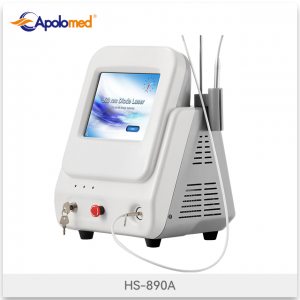
As a premier 980nm diode laser manufacturer, APOLOMED engineered the flagship APOLOMED HS-890A platform for advanced vascular interventions and soft-tissue surgery. The rapid global expansion of minimally invasive surgery continues to accelerate market growth for semiconductor laser systems across surgical specialties.
| Metric | Details |
|---|---|
| 2024 Base Market Value | USD 1.2 Billion |
| 2033 Projected Market Value | USD 2.14 Billion |
| Compound Annual Growth Rate (CAGR) | 7.5% (2026–2033) |
This technical evaluation provides B2B buyers, distributors, and surgical specialists with a clinical decision matrix for evaluating single wavelength and dual wavelength hardware platforms.
Biophysics of 980nm Laser vs 1470nm Wavelengths
Understanding chromophore absorption remains essential for optimal wavelength selection in soft-tissue surgery. Semiconductor laser systems emit specific light frequencies that interact uniquely with target tissue components.
Absorption Profile of the 980nm Laser
The 980nm laser offers a balanced absorption profile by targeting both water and hemoglobin simultaneously. Hemoglobin absorption enables a strong coagulation effect, making this wavelength an ideal choice for blood-rich structures.
| Wavelength | Primary Tissue Target / Absorption Characteristics |
|---|---|
| 980 nm | Features dual absorption, targeting hemoglobin (blood) more significantly alongside water. |
| 1470 nm | Characterized by predominant water absorption (in cellular and vein wall structures), with an absorption coefficient in water roughly 50 times higher than that of 980 nm. |
A 980 nm semiconductor diode laser exhibits an optical penetration depth of approximately 2 to 3 mm in soft human tissue. This deeper penetration provides uniform tissue heating and solid hemostasis during invasive operations.
Clinical Insight: Dual chromophore targeting allows medical specialists to achieve robust vascular closure and effective thermal hemostasis simultaneously.
Water Targeting Precision of the 1470nm Laser
The 1470nm laser focuses primarily on cellular water instead of blood pigments. Cellular fluid absorbs energy rapidly when clinicians apply a 1470 nm wavelength diode system.
Because the 1470 nm wavelength has a water absorption rate approximately 40 times greater than that of 980 nm, energy is targeted and absorbed much more efficiently by interstitial water. Medical professionals complete accurate vaporization procedures using reduced energy parameters. Consequently, controlled thermal action vaporizes target regions smoothly without disrupting delicate structural boundaries.
Optical Penetration Depth and Collateral Thermal Spread
Energy absorption characteristics dictate optical energy dispersion and collateral thermal spread in soft-tissue surgery. The 980 nm laser drives energy deeper into vascular targets to deliver reliable coagulation across broader treatment areas.
Conversely, high water absorption at 1470 nm concentrates energy near the tissue surface. Shallow thermal impact limits deep heat propagation, protecting adjacent healthy structures during surgery. Doctors select these laser tools based on whether the procedure requires deeper penetration for vascular hemostasis or shallow ablation for delicate structural preservation.
Clinical Applications in Vascular and Soft Tissue Surgery
Modern laser medical platforms perform critical clinical tasks across multiple specialties. Clinicians utilize distinct optical energy profiles to optimize patient care and speed surgical recovery.
Vascular Lesion Treatment and Endovenous Ablation
Surgeons frequently perform endovenous laser ablation to treat severe varicose veins. High water absorption allows a 1470 nm wavelength to target vein wall cellular water directly. Radiating energy through a radial fiber creates uniform vessel closing while limiting deep thermal energy damage. Clinical trial data shows that endovenous laser treatment using 1470 nm optical fibers achieves a 100% complete occlusion rate at 12 weeks.
| Laser Wavelength & Delivery Optics | Occlusion Rate | Post-Op Pain Level | Thermal Damage Risk |
|---|---|---|---|
| 1470 nm Laser (Radial Fiber) | 100% at 32 months | Minimal local pain | Low tissue spread |
| 980 nm Laser (Bare Fiber) | 98.1% at 7 months | Moderate pain | Broader thermal footprint |
Targeting blood vessels directly requires precise light emission. The APOLOMED HS-890A utilizes target hemoglobin absorption at a primary 980 nm wavelength to deliver strong blood coagulation. Practitioners execute targeted vascular procedures for spider veins, cherry angiomas, and linear telangiectasia efficiently. The device delivers flexible Continuous Wave, Single, and Repeat pulse modes with adjustable 15W or 30W power settings. This high power versatility gives surgeons complete control during delicate vascular treatments.
| Post-operative Clinical Metric | 980 nm (Group 1) | 1470 nm (Group 2) | Statistical Significance |
|---|---|---|---|
| Ecchymosis Severity | 13 patients reported ecchymosis | Minimal ecchymosis observed | p < 0.05 |
| Analgesic Requirement | Higher medication need | Lower medication need | p < 0.05 |
Laser Lipolysis and Endolifting Procedures
Aesthetic specialists utilize combined laser technology for body contouring and facial reshaping. A 980 nm laser targets adipocytes efficiently to promote uniform fat melting without high power levels. Meanwhile, a 1470nm laser targets extracellular water to trigger immediate tissue contraction and collagen remodeling.
| Wavelength / Technique | Target Chromophore & Mechanism | Primary Clinical Outcome |
|---|---|---|
| 980 nm Wavelength | High hemoglobin and fat cell absorption | Uniform fat solubilization for laser lipolysis |
| 1470 nm Wavelength | High cellular water absorption | Deep tissue tightening and collagen stimulation |
| Dual Wavelength Strategy | Simultaneous water and lipid targeting | Effective fat reduction with minimal thermal stress |
Combining dual wavelengths in laser lipolysis optimizes fat breakdown while achieving superior collagen synthesis. Specialists complete aesthetic procedures safely because balanced laser energy limits overall thermal injury.
Minimally Invasive Soft Tissue Surgeries
Surgical teams perform minimally invasive surgery across proctology, ENT, and gynecology specialties. Each specific soft-tissue surgery benefits from controlled thermal coagulation and shallow optical penetration depth.
Clinical Insight: Matching optical absorption parameters to target tissue composition reduces intraoperative bleeding and accelerates overall patient recovery.
The 980 nm emission ensures precise soft-tissue surgery cutting while maintaining continuous hemostasis. High water absorption at 1470 nm provides smooth tissue vaporization without harming nearby structures. Consequently, advanced multi-wavelength systems expand broad clinical applications while improving standard surgical performance.
Hardware Standards from a 980nm Diode Laser Manufacturer
Selecting optimal medical hardware requires a thorough evaluation of optical transmission systems and clinical versatility. Leading equipment producers construct advanced devices to handle challenging surgical environments.
Fiber Delivery Optics and SMA 905 System Design
Optical delivery components determine how effectively energy impacts target tissue during surgery. Clinicians select specific light delivery fibers based on treatment depth and structural target locations.
| Characteristic | Bare Optical Fiber | 360-Degree Radial Fiber |
|---|---|---|
| Outer Diameter & Flexibility | Smaller diameter (600 µm); less stiff and easier to maneuver. | Larger outer diameter (1.85 mm); stiffer, making navigation through tortuous or aneurysmal veins more challenging. |
| Light Dispersion & Heat Impact | Concentrates energy forward, leading to a higher risk of laser heat-induced vein wall perforation. | Emits light radially (360 degrees), offering a different energy distribution that reduces direct vein wall perforation risks. |
Top engineering teams utilize standardized connector hardware to guarantee optical transmission safety:
- Secure Alignment & Connection: Threaded couplers with durable stainless-steel ferrules precisely align optical fibers with the system output deck.
- Thermal Resistance: High-temperature resistant adhesives isolate laser heat away from the fiber core to protect delicate internal mechanics.
- Robust Durability: Threaded connections conform to international standards and easily endure over 1000 mating cycles.
APOLOMED HS-890A Engineering Specifications
As an established 980nm diode laser manufacturer, APOLOMED designed the HS-890A system for superior precision across diverse clinical settings. The platform integrates an SMA 905 connector interface alongside a 655nm red aiming beam for accurate beam placement. Practitioners customize settings via an intuitive 8-inch color touch screen, selecting pulse durations from 5ms to 400ms and repetition rates up to 50Hz. The 8kg compact chassis operates quietly with an integrated air-cooled system and accepts universal AC power sources worldwide.
Thermal Management and Quality Certifications
Effective internal cooling prevents thermal overload and protects sensitive semiconductor diodes during long surgical procedures. Proper heat dissipation maintains stable optical power output and ensures consistent energy density.
International certification standards help procurement teams verify device safety and regulatory compliance:
| Certification / Clearance | Regulatory Focus & Scope | Impact on International B2B Procurement |
|---|---|---|
| ISO 13485 | Facility Quality Management System (QMS) audit for a specific site and operational scope. | Establishes factory-level quality processes; does not grant product-specific market authorization or automatic clearance. |
| FDA 510(k) | Device-specific market clearance for a precise model and stated intended use. | Authorizes commercial distribution for a specific medical device configuration; does not imply overall factory ISO compliance. |
| MDSAP | Single regulatory audit of a QMS evaluated against criteria across multiple participating jurisdictions. | Streamlines multi-country regulatory compliance evaluations for global supply chains. |
Procurement Screening Rule: B2B buyers must rigorously verify that legal entities, manufacturing facilities, operational scopes, and device configurations match across all regulatory records.
A reputable 980nm diode laser manufacturer maintains complete compliance across key standards, including ISO 13485, CE 0197, SGS ROHS, and US FDA clearance. These rigorous quality approvals ensure reliable vascular care and soft tissue performance for modern clinics.
B2B Procurement Matrix for Single vs Dual Wavelength Platforms
Hospital procurement teams and private clinic owners evaluate medical devices based on clinical capability and investment return. Choosing the right hardware platform directly influences practice revenue and clinical expansion.
Clinical Versatility and Multi Specialty ROI
Single wavelength devices offer high financial returns for specialized clinics. A dedicated 980 nm system delivers exceptional power for target vascular therapies, pain management, and lipolysis procedures. Clinics maximize device utilization rates by focusing on high-demand vascular treatments.
Financial ROI = (Annual Practice Revenue - Equipment Cost) / Equipment Cost x 100Multi-specialty surgical centers often require diverse optical profiles. Practicing surgeons utilize specific energy absorption paths to treat varying target tissue depths. A platform offering dual wavelength options expands treatment menu capabilities across aesthetic, phlebology, and general surgical care.
Procurement Tip: High-volume specialized clinics achieve faster capital recovery with target single wavelength units, whereas multi-specialty centers maximize room turnover using dual energy platforms.
Evaluating Dual Wavelength Diode Laser Platforms
Proper wavelength selection determines surgical efficacy across diverse clinical applications. The 980 nm emission provides excellent target blood coagulation and robust thermal hemostasis. Meanwhile, a 1470 nm emission delivers precise target water absorption for delicate soft-tissue surgery.
Medical buyers must evaluate hardware reliability alongside optical delivery accessories. A leading 980nm diode laser manufacturer provides durable delivery systems to safeguard internal optics during long operations. Modern platforms deliver controlled thermal energy safely to prevent unintended thermal spread.
- Surgical Precision: Combining 980 nm and 1470 nm energy options allows custom thermal delivery for laser lipolysis and complex minimally invasive surgery.
- Operational Efficiency: Flexible emission settings streamline outpatient surgery workflows across specialized clinical applications.
Selecting robust laser hardware helps medical facilities optimize clinical outcomes and reduce equipment downtime significantly.
Dual-wavelength platforms offer unique optical advantages in modern surgery. The 980nm laser targets hemoglobin to deliver deeper penetration alongside effective tissue coagulation. Conversely, the 1470nm wavelength targets cellular water to drive precise soft tissue ablation and smooth endovenous closure.
Key Clinical Takeaway: Matching specific light emission profiles to structural chromophores maximizes vessel coagulation while preserving adjacent healthy structures.
Medical practices select the APOLOMED HS-890A platform as a premier solution for high-demand clinical environments. This system delivers consistent power across vascular care, pain management, and specialized aesthetic treatment.
As an industry-leading 980nm diode laser manufacturer, APOLOMED provides full platform customization for global partners:
- Branding & Interface Customization: Private label logo printing, custom shell design, and multilingual software interfaces.
- Operational Parameter Tuning: Tailored laser energy settings for specific vascular target reach and clinical treatment requirements.
- Core Hardware Configurations: Flexible output power levels, integrated water or air cooling mechanisms, and custom delivery optics.
Contact APOLOMED today to request factory procurement quotes and initiate direct OEM/ODM platform customization.
FAQ
How do these two wavelengths differ in soft tissue surgery?
The 980 nm wavelength targets hemoglobin and water to produce deep tissue coagulation. Conversely, the 1470 nm wavelength targets water absorption to minimize thermal damage during delicate surgery.
Which option performs best for varicose veins care?
Physicians perform endovenous laser ablation using a 1470 nm emission. High water targeting ensures vessel wall collapse, whereas 980 nm energy drives blood coagulation during endovenous laser treatment.
What surgical applications benefit most from laser thermal hemostasis?
Vascular surgery applications rely on direct laser hemostasis. Strong thermal action targets liquid water and cellular components, accelerating rapid vascular coagulation and soft tissue coagulation.
Post time: Aug-05-2026


