A dual-wavelength non-ablative fractional laser is most useful when a clinic builds a layered resurfacing service instead of marketing 1550nm and 1927nm as interchangeable settings. The wavelengths support different treatment strategies, while scan control, cooling, staff training, and patient-selection governance determine whether the service is operationally sustainable. This guide uses the Apolomed HS-232 as a documented equipment example and focuses on service design: how to structure consultations, choose the relevant wavelength pathway, plan room resources, and measure the program without repeating the procurement-acceptance framework used for ablative CO2 systems.
Build the Service Around Layered Clinical Questions
The starting question is not “Which wavelength is stronger?” It is “Which layer and concern is the clinical team evaluating, and what is the documented role of each wavelength?” A 2025 peer-reviewed review of dual 1550nm erbium-glass and 1927nm thulium fractional systems describes distinct mechanisms and emphasizes personalized treatment planning based on factors such as treatment area and Fitzpatrick skin type. That evidence supports a layered service model, but it does not transfer any other manufacturer's settings, indication list, or regulatory status to the HS-232.
1550nm: Position the Pathway Around Dermal Remodeling
The current dual-wavelength review associates 1550nm with concerns that include fine lines and several scar types, among other applications. For a clinic, this suggests a consultation pathway centered on texture and remodeling rather than an undifferentiated “rejuvenation” package. A qualified clinician still needs to determine candidacy, indication, and settings for the exact device.
1927nm: Create a Separate Surface-Focused Conversation
The same review discusses 1927nm in relation to more superficial concerns, including dyschromia and pigmented lesions. This supports a separate surface-focused consultation track instead of presenting 1927nm as simply a lighter version of 1550nm. The service script should distinguish what the literature says about this technology class from what the local label and the HS-232 documentation authorize. It should never promise a universal recovery period or outcome.
Combination pathways require the same discipline. A 2022 journal article on another 1550/1927nm dual system reports that expert recommendations included individual and combined use across selected on-label and investigational applications. That supports the relevance of dual-wavelength planning, not a copy-and-paste protocol for HS-232. Combination use must follow the applicable instructions, clinician training, and local requirements.
Translate the HS-232 Configuration Into a Service Menu
The Apolomed HS-232 product page presents both a 1550+1927nm configuration and a 1927nm-only configuration. The distinction affects far more than the purchase price. It determines whether the clinic can build two wavelength-specific consultation pathways on one platform or should design a narrower surface-focused service.
| Manufacturer-Listed Item | Dual-Wavelength Configuration | 1927nm Configuration |
|---|---|---|
| Wavelength | 1550nm + 1927nm | 1927nm |
| Laser power | 15W + 15W | 15W |
| Laser output | 1550nm: 1–120mJ/dot; 1927nm: 1–100mJ/dot | 1–100mJ/dot |
| Pulse width | 1550nm: 1–20ms; 1927nm: 0.4–10ms | 0.4–10ms |
| Shared scan controls | 9–255 PPA/cm² in 13 levels; maximum 20 × 20mm scan area; Array and Random modes | |
These values are manufacturer-listed ranges, not treatment recommendations. The clinic should confirm which column applies to the quotation, how the interface labels each wavelength, and whether the supplied handpiece and software match the selected configuration. Do not combine the maximum output, pulse width, density, and field size into an assumed operating point.
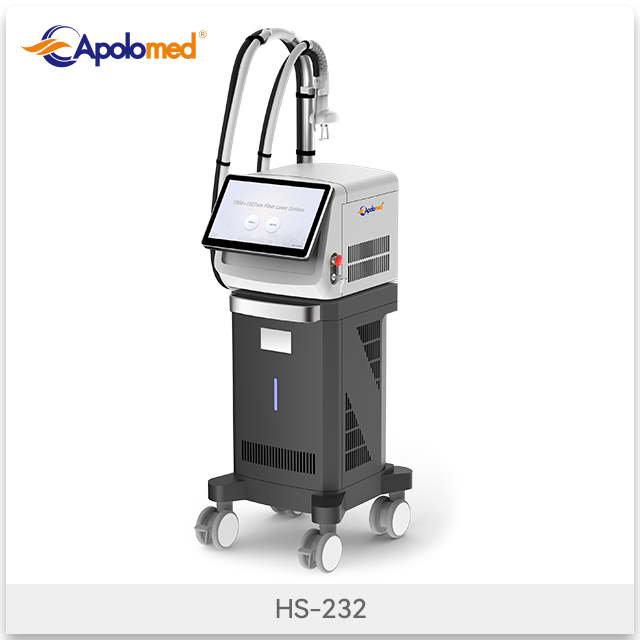
Apolomed HS-232 product image. Confirm whether the quotation covers the dual-wavelength or 1927nm-only configuration.
Design the Consultation Before Designing the Package
A low-downtime positioning does not remove the need for careful clinical screening. Build a consultation template before creating package names or revenue forecasts. It should help the qualified provider document the primary concern, relevant skin characteristics, medical history, previous procedures, expectations, recovery constraints, and whether the contemplated use is supported by the device documentation and local scope-of-practice rules.
Use Three Routing Questions
- What is the primary layer and concern? Separate a remodeling-led discussion from a surface-focused discussion.
- What recovery window and risk factors matter? Avoid turning “non-ablative” into a no-downtime or no-risk promise.
- Is the contemplated use documented for this system? Check the current instructions, clinician qualifications, and destination-market requirements.
These questions create a consistent decision trail without prescribing settings. They also expose cases in which one consultation contains multiple priorities. The clinician may decide that a single wavelength, a staged plan, another modality, or no treatment is more appropriate. Marketing should never force every enquiry into the same package.
Keep Consent and Marketing Language Aligned
If a webpage calls the service “gentle” or “minimal downtime,” the consultation must still discuss realistic variability, alternatives, aftercare, and potential adverse effects according to the applicable professional standard. Avoid fixed session counts, universal skin-type claims, and before-and-after guarantees. Non-ablative describes how the technology delivers energy; it does not certify that every patient will have the same experience.
Treat Scan Geometry as a Workflow Tool
The HS-232 page lists multiple shapes, a hand-drawing function, Array and Random modes, and a maximum 20 × 20mm scan area. These features can support workflow around regular and irregular zones, but their value should be assessed through operator usability and documentation rather than the number of icons on a screen.
Separate Field Shape From Treatment Density
A selected field shape defines where the scanner is intended to deliver dots. Density defines a dot count per area under the manufacturer's terminology. Neither number alone establishes treatment depth, coverage percentage, clinical endpoint, or recovery time. During staff training, operators should be able to identify the active wavelength, field boundary, density level, scan mode, and confirmation sequence before emission.
Use Hand-Drawn Areas as a Controlled Feature
Freehand boundary creation can help define irregular areas, but the workflow must include preview, reset, orientation, and final confirmation. Ask the manufacturer or authorized trainer to demonstrate the exact software revision. Record screenshots or training references permitted by the supplier. The objective is repeatable use of the interface, not an improvised protocol for sensitive anatomical areas.
RFID-based management is another manufacturer-listed feature. If the clinic plans to use it for access, membership, or rental workflows, request a demonstration of permissions, data fields, exports, account recovery, and service continuity. A feature should enter the business case only after the team confirms how it works and who will administer it.
Plan Cooling as a Separate Capacity Decision
The HS-232 product page also describes an HS-232A air-cooling system. Its presence should not be inferred from the main laser image or from the phrase “with cooling system.” Confirm whether the cooling unit is integrated, bundled, or separately quoted, and identify its electrical, floor-space, maintenance, and replacement-supply requirements.
| HS-232A Published Specification | Manufacturer-Listed Value | Operational Question |
|---|---|---|
| Cooling temperature | –25°C | How is this measured, controlled, and displayed? |
| Airflow | Five adjustable levels | How is the setting incorporated into training and room workflow? |
| Power output | 700W | What electrical capacity and circuit arrangement are required? |
| Tube length | 2.5m | Can staff position the device without obstructing circulation? |
| Dimensions and weight | 48 × 48 × 80cm; 37kg | Where will it be stored, cleaned, serviced, and moved? |
Apolomed states that the cooling system can reduce discomfort and thermal damage. Treat this as a supplier claim, not a substitute for patient assessment or a guarantee of comfort. The clinic should define who operates the cooling unit, how it is checked before use, and how failures affect scheduling. Cooling needs belong in room and capacity planning even when the system is quoted as an accessory.
Measure the Program Without Relying on Treatment Hype
A clinic should decide how it will evaluate the service before setting monthly targets. Revenue alone cannot show whether the consultation process, scheduling model, and support plan are working. Build a small operating dashboard using local data and definitions that the team can reproduce.
Track Four Operational Measures
- Consultation-to-service conversion: segment by the pathway recommended, not only by the marketing source.
- Room time: measure the full appointment cycle, including setup, documentation, and turnover.
- Schedule disruption: record equipment-related delays separately from patient rescheduling.
- Follow-up completion: monitor whether the clinic delivers its planned review process rather than treating the transaction as finished at checkout.
Do not use an assumed number of sessions or an invented average treatment price to prove ROI. A more defensible contribution calculation is collected service revenue minus clinician time, room time, financing, maintenance allocation, cooling-system costs, consumables, marketing, refunds, and downtime. Run conservative and expected scenarios using the clinic's own figures.
Keep Clinical Outcomes Under Professional Governance
Operational metrics do not replace clinical outcome measurement or safety reporting. Qualified clinicians should define appropriate documentation, photography, follow-up, escalation, and adverse-event processes under applicable standards. Avoid turning a small internal sample into a universal claim. Marketing teams should use only consented, representative materials and state conditions that materially affect interpretation.
When the HS-232 Service Model Makes Sense
The dual-wavelength HS-232 configuration is most relevant to clinics that want distinct surface-focused and remodeling-focused consultation pathways, have qualified clinicians to select patients and manage follow-up, and can support training on wavelength, scan mode, density, and field controls. The 1927nm-only configuration may fit a narrower strategy, but it should not be presented as equivalent to the dual system.
This service model is less suitable when the business case depends on universal “no downtime” messaging, unverified off-label applications, or settings copied from another platform. It is also premature if the clinic has not identified who owns consultation standards, equipment competency, aftercare, follow-up, and service interruption planning.
A complete decision requires the current manual, local regulatory review, configuration-specific quotation, warranty and training scope, and confirmation of whether the HS-232A cooling system is included. The most useful next step is to request a live HS-232 workflow demonstration that covers wavelength selection, scan controls, irregular-area setup, and cooling integration.
FAQ: Dual-Wavelength Non-Ablative Fractional Laser Services
Are 1550nm and 1927nm interchangeable?
No. Current literature describes different mechanisms and clinical roles for the two wavelengths. A clinic should route consultations according to the concern, tissue target, device documentation, and clinician judgment. It should not use the same package description for both. Even when both wavelengths are available on one system, combination treatment is a separate clinical decision rather than an automatic upgrade.
Does non-ablative mean no downtime?
No. “Non-ablative” distinguishes the treatment mechanism from tissue-vaporizing resurfacing; it does not promise an identical recovery experience for every person. Recovery varies with the individual, area, settings, treatment plan, and other factors. Marketing should use conditional language, while the clinical consultation provides device- and patient-specific counseling.
Is the HS-232A air-cooling system included with the laser?
The product page describes the HS-232A system and lists its specifications, but the page does not establish that it is included in every quotation. Ask whether it is integrated, bundled, or optional. Confirm freight, power, floor-space, warranty, maintenance, training, and service responsibilities separately from the main laser.
Can published protocols for another dual-wavelength laser be used on HS-232?
No automatic transfer should be assumed. Peer-reviewed work on other systems helps explain why dual-wavelength technology matters, but settings and indications depend on device design, labeling, training, patient factors, and jurisdiction. Use the current HS-232 instructions and qualified clinical guidance. This article intentionally provides service-design questions rather than treatment parameters.
Post time: Oct-08-2026


