Before buying a fractional CO2 laser machine, confirm exactly what the quoted system delivers: documented pulse and scan controls, the correct handpieces, a workable room setup, and a service agreement that covers the equipment you receive. A demonstration should establish these points, not simply show a high power rating. This clinic procurement checklist uses the Apolomed HS-411 as a documented product example and follows the purchase from configuration review to delivery acceptance. Its focus is skin resurfacing equipment, not hair removal technology or a comparison of pigment-treatment lasers.
Define the Resurfacing Service Before Choosing the Hardware
Begin with the service your clinical team is qualified and equipped to provide. A practice evaluating skin resurfacing has a different purchasing brief from a facility adding surgical cutting. Write down the intended service, the responsible clinician, the required attachments, and the support needed before reviewing optional features. This prevents a multifunction brochure from becoming a purchase specification by default.
Fractional Describes Delivery, Not an Absence of Ablation
The manufacturer's HS-411 technical page describes a 10,600nm CO2 source whose energy is absorbed by water in tissue, producing vaporization and an adjacent thermal effect. Its fractional delivery creates separated treatment channels rather than uniformly treating the entire surface. Fractional CO2 resurfacing is therefore an ablative approach; “fractional” and “ablative” should not be presented as opposite technologies.
For procurement, the relevant question is how the system controls this delivery and how the clinical team will manage assessment, consent, aftercare, and follow-up. The purchasing team should not translate a description of tissue effects into a guaranteed outcome or a fixed recovery period. Those decisions require qualified clinical judgment and the instructions supplied for the exact device.
Keep Optional Applications Outside the Core Business Case
The Apolomed HS-411 product page presents fractional, cutting, and vaginal-care attachments. This guide evaluates the resurfacing purchase only. Other applications need their own assessment of documentation, intended use, training, and local requirements. Do not count revenue from an optional application merely because an accessory appears in a product photograph.
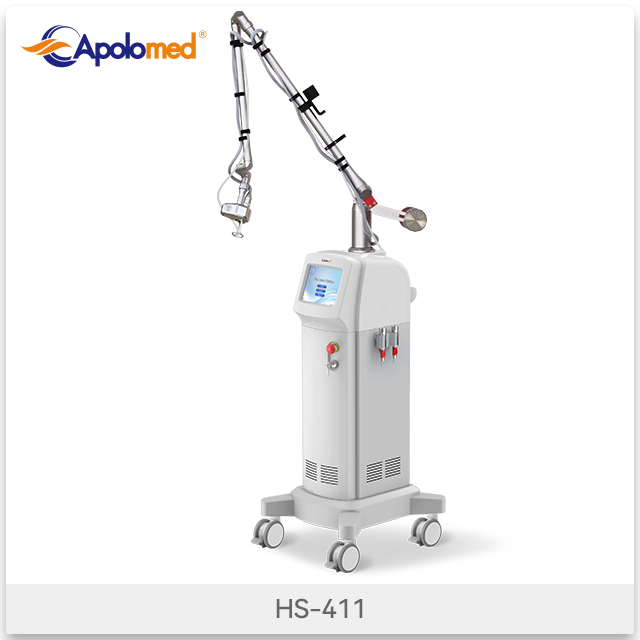
HS-411 product photograph from Apolomed. Confirm the supplied arm, handpieces, and configuration against the quotation.
Turn Published Specifications Into a Configuration Schedule
A useful configuration schedule names each component and identifies the document supporting it. This matters when different manufacturer pages describe different options. The HS-411 global page lists 35W, 55W, and 100W systems for selection, while the separate technical page lists a 35W specification. These are published descriptions, not proof that all capabilities or maxima are available together.
Use the following table to prepare a configuration-specific quotation. The figures are manufacturer-listed specifications from the linked pages, not independent output measurements. Ask the supplier to identify the revision and applicable configuration before treating them as purchase commitments.
| Specification | Manufacturer-Published Detail | What to Confirm in Writing |
|---|---|---|
| Source and wavelength | RF sealed-off CO2 laser; 10,600nm on the technical page | Source identification, output documentation, and service coverage |
| Laser power | 35W on the technical page; 35W / 55W / 100W options on the global page | The exact ordered version and the measurement conditions |
| Energy per dot | 1–300mJ/dot on the technical page; up to 300mJ/microbeam on the global page | Definitions, available settings, and limits for the selected mode |
| Density and scan field | Global page: 25–3025 microbeams/cm²; maximum 20 × 20mm field | Density units, field dimensions, and permitted parameter combinations |
| Patterns and shapes | Technical page: Array and Random; square, hexagon, triangular, circular, and freehand shapes | Controls and software functions included with the purchased scanner |
| Pulse duration | Adjustability is described; no numeric range is confirmed here | Current manual, units, range, and mode-dependent restrictions |
The table is deliberately not a ranking. Maximum laser power, energy per dot, and scan density describe different aspects of the equipment. Comparing one in isolation can obscure the operating combinations that the clinic actually needs. Attach the agreed schedule to the quotation so the demonstration and delivered unit can be checked against the same baseline.
Evaluate Scan Control, Not Just the Power Rating
A fractional CO2 laser demonstration should make the controls understandable to the people who will use and maintain the system. Request a manufacturer-approved equipment demonstration by qualified personnel, separate from any patient treatment. The objective is to observe the interface, confirm documented functionality, and record questions that a sales specification alone cannot resolve.
Read Energy, Density, and Field Size Together
Ask the demonstrator to explain what changes when a field is resized or a density setting is adjusted. Does the interface retain the other settings, restrict a combination, or request confirmation? Record the behavior rather than assuming that separately listed maximum values can operate simultaneously. Also distinguish the area of the complete scan from the size of an individual treatment dot.
Density expressed as microbeams per unit area is not, by itself, a percentage of skin coverage. Converting it into coverage requires a defined dot size and an explanation of spacing and overlap. If a supplier uses percentages in a comparison chart, ask for those definitions. This makes comparisons more meaningful without turning a buyer's guide into a treatment-settings manual.
Check Random Scanning and Freehand Boundaries
Apolomed describes its Random mode as delivering microbeams in an alternating direction to allow treated microzones to cool. Treat the associated comfort and downtime statements as manufacturer claims, not guaranteed clinical results. For purchasing purposes, establish which scanning sequences the quoted software includes and how operators identify the active sequence before emission.
The global page also describes independently adjustable axes and a drawing function. Ask to see how a selected shape is previewed, resized, reset, and confirmed. The practical value is a clearly understood workflow, not simply a larger menu of shapes. Record the demonstrated software version; an older brochure screenshot may not represent the controls on the unit being ordered.
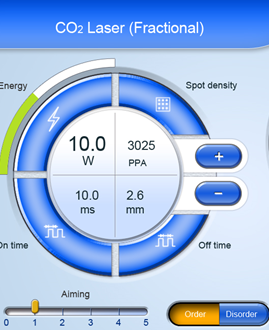
Manufacturer interface illustration. Labels, units, and software version must be checked against the supplied manual; displayed values are not treatment recommendations.
Include Room Readiness in the Purchase Decision
A device can fit through the doorway and still be difficult to integrate into a treatment room. Before committing to a layout, map the bed, operator position, articulated-arm movement, equipment access, and supporting devices. Request the installation instructions for the ordered configuration rather than applying dimensions or electrical details from another version.
Do Not Confuse Equipment Cooling With Plume Management
The HS-411 technical page lists air cooling. That specification does not establish that a smoke evacuation system is included. The International Society of Plastic and Aesthetic Nurses' smoke evacuation position statement, drafted in September 2020, recommends functioning room ventilation and smoke evacuation for plume-generating procedures. It is an older professional guidance source, not a statement of current law in every jurisdiction; the clinic should confirm current local requirements.
Ask whether the proposed package includes an evacuator, compatible accessories, initial filters, and training. Have the clinical safety lead review capture arrangements, protective equipment, waste handling, and replacement supplies against current guidance. Treat these as installation and operating expenses, not optional marketing extras. A cooling label on the laser brochure cannot answer these separate questions.
Finally, include appointment preparation, room turnover, documentation, and follow-up capacity in the launch plan. A scan demonstration measures only part of the service workflow. It should not become the basis for a full-day patient-throughput promise without observing the other tasks that the clinic must perform.
Agree on Delivery Acceptance Before Paying the Balance
Acceptance is the link between what was promised and what arrives. Propose a written process before ordering: which documents are required, who performs installation checks, how discrepancies are reported, and which milestones apply to final acceptance. These are contract recommendations, not claims about Apolomed's standard commercial terms. Negotiate them for the actual transaction.
Match the Paperwork to the Delivered Configuration
The supplier pages display certificate references including CE and US FDA. Those website labels alone do not verify the regulatory status or intended use of a particular delivered unit. Ask for the underlying documentation, identify the legal manufacturer and relevant model, and have the person responsible for regulatory compliance assess its scope in the destination market. This article does not independently verify HS-411 regulatory authorization.
| Acceptance Item | Evidence to Retain |
|---|---|
| Identity and accessories | Nameplate details, serial numbers, packing list, and agreed handpiece schedule |
| Output and scanner checks | Qualified service report stating the approved method, measurement equipment, and manufacturer-defined acceptance limits |
| Software and controls | Version record and documented demonstration of the functions included in the quotation |
| Installation and safety | Installation sign-off and authorized checks of safety controls and required supporting equipment |
| Training and support | Training record, current manual, warranty scope, and named service escalation route |
Do not invent a universal pass/fail tolerance or attempt internal adjustments during acceptance. The supplier's qualified service personnel should use the approved procedures and document the results. A clinic's role is to obtain and review that evidence, identify gaps, and record agreed corrective action before the equipment is released for clinical use.
Price the Service Plan, Not Only the Main Unit
For a resurfacing platform, purchasing analysis should separate the main unit from the source, delivery arm, scanner, accessories, and supporting equipment. Ask the supplier which components have separate warranties, which require scheduled service, and who can perform that work locally. A broad warranty headline does not answer whether labor, shipping, optical components, or a replacement unit are covered.
Compare Quotes Using the Same Cost Boundary
Use the same ownership period and assumptions for every proposal. Include freight, installation, staff training, planned maintenance, applicable replacement supplies, and the cost of arranging service. Request quoted prices and lead times for major replacement components rather than assigning a generic laser-tube lifespan. No fixed HS-411 replacement interval or market purchase price is assumed here.
Cost comparison framework: acquisition and setup + planned service + replacement supplies + training and support + a separately stated downtime allowance. Identify what each quote already includes to avoid double counting.
A downtime allowance is a scenario, not a prediction. Build it from the clinic's own contribution margin and possible cancellations, and distinguish postponed appointments from genuinely lost revenue. Run the business case without unapproved specialty services or assumed premium pricing. A proposal remains attractive only if the clinic can support it under realistic staffing, follow-up, and service-access conditions.
Make the Shortlist Decision With a Written Evidence Pack
The HS-411 offers a useful starting point for a documented evaluation because its public pages identify the source, scanning choices, and several configuration options. Inclusion on a shortlist is not an endorsement of every website claim. The next decision is whether the supplier can connect those descriptions to a specific quotation, a clear demonstration, and a supportable installation.
A clinic ready to evaluate this platform should have a defined resurfacing service, a responsible clinical lead, and the capacity to review the equipment and service documents. If those foundations are missing, buying extra power or attachments will not resolve the gap. Keep unresolved items visible rather than replacing them with an overall score that hides important omissions.
The strongest purchasing file is not necessarily the thickest brochure. It is the one in which the ordered configuration, operating documentation, acceptance criteria, and service responsibilities agree. For an HS-411 evaluation, request a configuration-specific quotation from Apolomed with that evidence attached.
FAQ: Fractional CO2 Laser Procurement
Is the highest-power fractional CO2 laser always the better purchase?
Not on the basis of power alone. The HS-411 pages illustrate why configuration matters: one lists 35W, while another presents several power options. Compare the documented combinations of energy, pulse control, scan field, and attachments for the actual quotation. A higher headline number does not establish better clinical results, a better service agreement, or a closer fit to the work your clinic is preparing to deliver.
Does microbeam density tell me the percentage of skin treated?
No. A number of microbeams per square centimeter describes a count per area, not an area percentage. A coverage calculation also needs an individual dot definition and information about spacing or overlap. Ask the manufacturer to explain the relationship used by the device and its software. Do not copy a competitor's coverage percentage onto the HS-411 simply because the displayed density numbers look similar.
Does Random scanning guarantee less downtime?
No guarantee is established by the manufacturer page. Apolomed describes a scanning sequence intended to allow local cooling, but that statement is not a universal recovery-time promise. Buyers should confirm the function in the ordered software and leave patient suitability, treatment planning, and recovery counseling to qualified clinicians. A demonstration can establish how a control behaves; it cannot establish the same clinical outcome for every patient.
What should be available before delivery acceptance?
Have the agreed configuration schedule, packing list, device identification, current instructions, installation records, and applicable regulatory documents ready for review. Include the qualified service checks agreed in the contract, plus training and warranty records. Resolve discrepancies through the supplier's authorized process rather than accepting verbal reassurance. Website badges and an attractive demonstration are useful starting points, but neither replaces the evidence that should accompany the delivered unit.
Post time: Oct-01-2026


