A modular aesthetic platform is usually the better expansion choice when a clinic wants to add several complementary services, has limited floor space, and can schedule those services through one shared console. Standalone lasers are usually stronger when one procedure already generates high appointment volume, several rooms must operate at the same time, or service continuity requires independent systems. The right decision is therefore not “more modules versus more machines.” It is a choice between flexible service breadth and dedicated treatment capacity.
Quick decision rule
Choose modular for staged service expansion, centralized operation, and space efficiency. Choose standalone for a proven high-volume service, parallel room use, or independent backup capacity. Consider a hybrid setup when a modular platform supports developing services while one established service remains on a dedicated workhorse.
What a Modular Aesthetic Platform Changes
A modular aesthetic platform combines a central console with interchangeable handpieces for different energy technologies. Instead of installing a separate chassis, interface, power system, and cooling architecture for every developing service, the clinic can select compatible modules around one operating platform. This can simplify room planning, reduce equipment footprint, and create a practical route for adding services in stages.
The Apolomed HS-900 platform illustrates this architecture. Its published commercial options span IPL, Q-switched Nd:YAG, long-pulsed Nd:YAG, fractional Er:YAG and Er:Glass, plus optional monopolar and bipolar RF categories. Interchangeable, auto-detected handpieces and upgradable software are intended to help a practice configure the system around its chosen service mix.
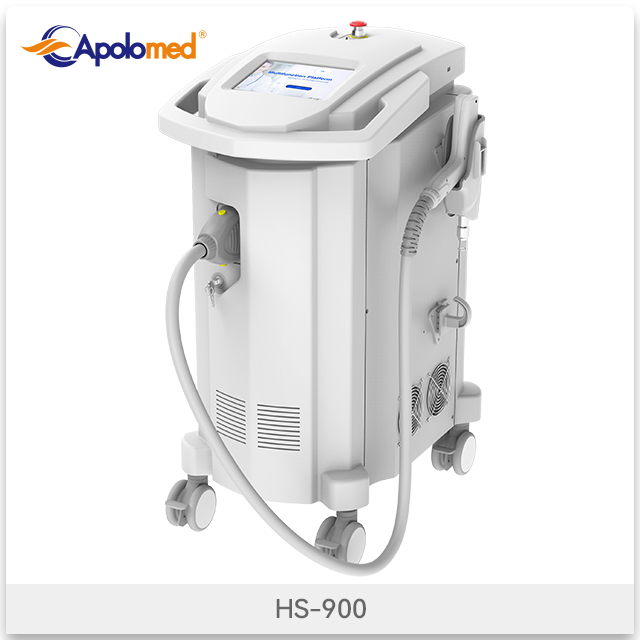
Apolomed HS-900 modular aesthetic platform with a shared console and interchangeable handpiece architecture.
This flexibility should be understood correctly. A multi-application platform broadens the services that can be configured through one console; it does not need to imitate several independent systems operating simultaneously to create value. Its strongest advantages are flexible configuration, lower space demand, centralized operation, and a clearer expansion path for clinics that are still building demand across multiple categories.
Start With the Clinic’s Expansion Goal
The number of available handpieces should not be the first selection criterion. Begin with the service gap the clinic needs to close. Review consultation requests, lost-booking reasons, referral patterns, current equipment utilization, room availability, and operator qualifications. This identifies whether the clinic needs broader capability, more capacity in an existing service, or both.
- Broaden the service menu: a modular system can support several related services without adding a full standalone chassis for each one.
- Increase capacity in one established service: a dedicated standalone system may provide a clearer scheduling and backup advantage.
- Use limited floor space more effectively: consolidation can preserve treatment-room flexibility.
- Test adjacent demand before making a larger commitment: staged module selection can align investment with verified bookings.
Classify each proposed service as ready now, next-stage expansion, or future option. A ready-now service already has demand, a qualified operator, a room workflow, consultation language, and a launch plan. A next-stage service has a relevant patient base but still needs training or promotion. Future options should remain outside the initial quotation unless their inclusion has a clear operational and financial purpose.
Translate HS-900 Modules Into Service Roles
The HS-900 product page publishes several handpiece families. The practical task is to connect each option to a distinct service role rather than repeating a long list of applications. The following summary uses manufacturer-published specifications as a configuration reference. Exact included handpieces, output ranges, filters, tips, software, and accessories remain quotation-dependent.
| Published Handpiece Category | Technical Snapshot | Clinic Planning Role |
|---|---|---|
| IPL SHR/EPL | Published 15 × 50mm spot and multiple wavelength filters | Broad light-based service line; confirm filters, cooling, pulse controls, and expected appointment volume |
| Q-switched 532/1064nm Nd:YAG | Published 1–5mm spot, <10ns pulse duration, and 1–10Hz repetition rate | Pigment and tattoo pathway; verify labeling, wavelengths, training, eye protection, and case-selection workflow |
| Long-pulsed 1064nm Nd:YAG | Published 10–40ms pulse duration with several spot-size options | Long-pulse laser pathway; determine whether it fills a new service gap or duplicates existing capacity |
| 2940nm Er:YAG / 1540nm Er:Glass | Published ablative and non-ablative fractional options | Fractional service expansion; evaluate room controls, recovery pathway, clinical governance, and whether both options are operationally justified |
| Monopolar / Bipolar RF | Manufacturer-listed optional RF handpieces and tips | Non-laser service extension; request tip inventory, replacement terms, software scope, and applicable documentation |
This table is intentionally selective. It gives the buyer enough technical context to plan a configuration without turning the article into separate treatment guides for every module. A handpiece creates business value only when the clinic can assign it to a clearly positioned service, a trained operator, a suitable room, and an achievable booking target.
Modular Platform vs. Standalone Lasers
Neither architecture is universally better. A modular platform is designed to make several developing services easier to house and expand. Standalone systems separate capacity and may suit mature service lines that need uninterrupted, high-volume use. Many clinics ultimately benefit from a hybrid model: one modular platform for flexible breadth and one or more standalone workhorses for established demand.
| Decision Factor | Modular Platform | Standalone Lasers |
|---|---|---|
| Best strategic use | Develop several complementary services in stages | Scale one or more proven, high-volume services |
| Floor-space planning | Centralizes compatible modules around one console | Requires space, power, storage, and installation for each system |
| Parallel appointments | Shared console requires coordinated scheduling | Independent systems can support simultaneous room use |
| Expansion timing | Add modules after demand and training are established | Add a complete system when capacity justifies it |
| Continuity planning | Requires a service plan for the shared console and module isolation | A fault is more likely to remain limited to one service line |
When a Hybrid Model Makes More Sense
A hybrid model is often the most practical long-term answer. For example, a clinic can use a modular platform to launch and validate several adjacent services, then add a standalone device when one of those services reaches a predefined capacity threshold. The platform continues to provide flexibility while the dedicated system absorbs high-volume demand. This avoids forcing one architecture to solve every stage of clinic growth.
Model Console Capacity Before Estimating ROI
The financial case for a modular platform should be based on booked console hours and contribution by module—not on the maximum number of applications in a brochure. One console can support several revenue pathways, but each appointment still consumes room time, operator time, setup, cleaning, and changeover capacity.
Use two utilization measures
Module utilization = booked hours for one module ÷ hours that module could be scheduled.
Console utilization = total booked platform hours ÷ usable console hours.
Module utilization shows whether an individual handpiece earns its place in the configuration. Console utilization shows whether the shared platform has enough remaining capacity for another service. A clinic should set a measurable expansion gate—for example, sustained demand, staff competency, room availability, and adequate spare console hours—before adding the next module.
Build conservative and expected scenarios using the clinic’s collected service revenue, financing, freight, import costs, installation, clinician time, room time, training, consumables, maintenance, marketing, cancellations, refunds, and downtime. Do not assign a fixed payback period before these local variables are known.
Plan the Room, Training, and Daily Workflow
The HS-900 product page lists an 8-inch touch interface, a published footprint of 65 × 48 × 115cm, and a weight of 72kg. These manufacturer-listed values should be confirmed against the quotation, shipping documents, electrical specification, device label, access route, and final installation plan.
The room plan must also account for handpiece storage, cable protection, cleaning stations, eye protection, ventilation or other module-specific controls, patient positioning, and changeover space. Define where each handpiece is stored, who checks it before use, how the console confirms the attached module, and how staff document cleaning and inspection.
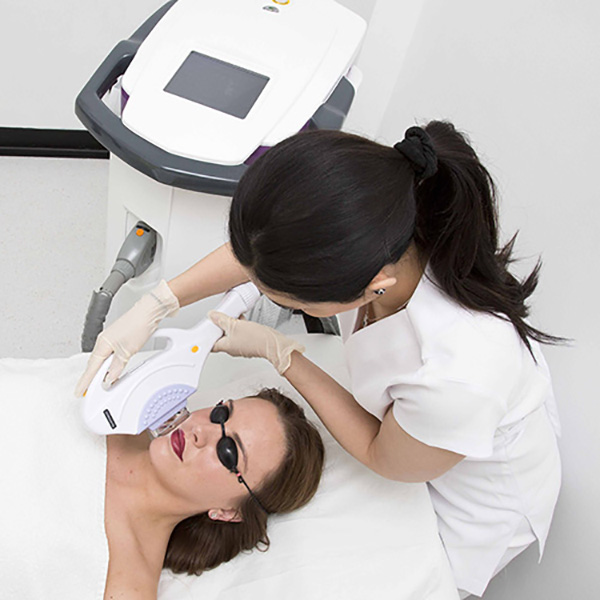
HS-900 handpiece operation demonstration. Training, room controls, and authorized use should be documented for each selected module.
Train by Module, Not Only by Console
One console orientation does not replace module-specific training. Each selected technology requires its own operator authorization, intended-use review, patient-selection process, parameter permissions, protective equipment, cleaning procedure, adverse-event response, and competency record. When a new module is added, the clinic should treat it as a new service launch rather than a simple accessory installation.
Build Service Continuity Into the Purchase
Centralization creates convenience, but it also makes service planning important. Before purchase, ask whether a single handpiece fault can be isolated while other modules remain available. Confirm remote diagnostics, response targets, spare-part availability, loan-unit policy, shipping responsibilities, software recovery, and the process for authorizing repairs.
Warranty terms should separate the console, laser sources, IPL lamp or cartridge, RF accessories, optics, cooling components, touchscreen, connectors, cables, and software. This component-level view supports more accurate ownership-cost planning and avoids treating a general warranty period as if every part had identical coverage.
- Can unaffected modules remain operational during a handpiece repair?
- Which spare parts are stocked in the clinic’s region?
- What evidence is required before remote or onsite service begins?
- Who pays for freight, customs, travel, and loan equipment?
- What scheduling or referral plan will protect patients if the console is unavailable?
Verify the Regulatory Scope by Configuration
The official FDA K203395 clearance record covers a Platform Treatment System. Its 510(k) summary identifies the proposed model as HS-900K and describes IPL, Q-switched Nd:YAG, and long-pulsed Nd:YAG handpiece categories, with indications defined by handpiece. This provides a useful official reference for those categories.
The current HS-900 commercial page also lists 2940nm Er:YAG, 1540nm Er:Glass, monopolar RF, and bipolar RF options. Their appearance on a product page does not by itself establish that they fall within K203395. For every quoted module, match the legal manufacturer, exact model, handpiece or part number, intended use, labeling, instructions, and applicable regulatory document. The manufacturer page also states TUV Medical CE; buyers should request the current certificate, covered models, scope, annexes, notified-body information where applicable, and declaration of conformity.
| Document Pack Item | What the Clinic Should Match |
|---|---|
| Configuration list | Main unit, every handpiece, filter, tip, cable, attachment, software option, and spare part |
| Regulatory record | Legal manufacturer, model, handpiece category, intended use, market, and current status |
| Training file | Authorized operators, module-specific competency, room controls, cleaning, and escalation process |
| Warranty and service schedule | Coverage by component, exclusions, response targets, spare parts, freight, software, and post-warranty support |
Use a Three-Stage Expansion Plan
A modular platform creates the most value when expansion follows evidence. The following model is not a fixed module prescription; it is a decision sequence that can be adapted to the clinic’s actual demand and authorized scope.
| Stage | Clinic Objective | Evidence Required Before Moving Forward |
|---|---|---|
| Stage 1: Launch | Select the strongest one or two demand-backed services | Qualified staff, room readiness, configuration documents, launch campaign, and booking target |
| Stage 2: Extend | Add an adjacent service for the same or a clearly defined patient base | Stable initial utilization, remaining console capacity, completed training, and a non-duplicative service role |
| Stage 3: Scale | Add higher-complexity modules or move a high-volume service to a standalone system | Demand history, governance, room controls, continuity plan, and a measured capacity constraint |
This staged approach keeps the HS-900’s breadth as a strategic advantage without requiring the clinic to operationalize every available category at once. It also creates a clear point at which a dedicated system becomes justified: when a service is proven, the shared console is approaching capacity, and parallel appointments would add measurable value.
Which Format Fits Your Clinic?
A modular platform is a strong fit when the clinic has limited space, wants to develop several related services, values centralized operation, and can schedule those services through one console. It is especially useful when expansion will happen in stages rather than all at once.
Standalone systems are a strong fit when one service already dominates demand, multiple rooms need to operate concurrently, the clinic requires a dedicated workflow, or an interruption to one device must not affect other service lines.
A hybrid strategy is a strong fit when the clinic wants flexible breadth but also has one mature service that needs dedicated capacity. The modular platform can support expansion and cross-service development while the standalone system protects throughput for the core service.
Conclusion: Configure for Growth, Then Scale With Evidence
A modular aesthetic platform and standalone lasers support different stages of clinic growth. The HS-900 offers a flexible way to consolidate selected technologies, preserve floor space, and add services in phases. Dedicated systems become more attractive when one service needs independent, high-volume capacity. The most effective purchasing strategy may therefore evolve from modular breadth to a measured hybrid fleet.
Build an HS-900 configuration around your clinic
Request a configuration-specific quotation and document pack for the modules your clinic plans to launch, including handpieces, accessories, training, regulatory records, warranty, and service support.
Frequently Asked Questions
Is an 8-in-1 platform the same as eight standalone machines?
No. The value of an 8-in-1 platform is access to several configurable service categories through one central system. Those handpieces share the platform architecture and schedule. A clinic should compare breadth, space efficiency, utilization, and expansion flexibility—not count the platform as eight independent systems operating at the same time.
Can different HS-900 handpieces operate simultaneously?
Do not assume parallel operation through one console. Ask for a live demonstration of the exact quoted configuration and written confirmation of handpiece switching, startup checks, changeover time, supported combinations, and whether a handpiece fault affects other functions. Use this information when calculating appointment capacity.
When should a clinic add a standalone laser after buying a platform?
Add a standalone system when one service has sustained demand, the shared console is creating a measurable scheduling constraint, multiple rooms could support simultaneous appointments, or continuity requires independent capacity. Set this utilization threshold before purchase so the clinic knows when to move from flexible expansion to dedicated scale.
Does FDA K203395 cover every module listed on the HS-900 page?
K203395 identifies an HS-900K Platform Treatment System and describes IPL, Q-switched Nd:YAG, and long-pulsed Nd:YAG handpiece categories. Other modules shown on the commercial page should be matched to their own applicable records and labeling. Request a configuration-specific document pack rather than transferring one clearance to every option.
What should the HS-900 quotation include?
The quotation should identify the main unit, each handpiece and attachment, filters, tips, cables, software, electrical requirements, freight, installation, module-specific training, warranty by component, replacement parts, service response, and regulatory documents for the exact configuration. The order should be detailed enough to inspect against the delivered equipment.
Post time: Oct-15-2026


