The right portable q switched laser for your clinic depends on three factors: treatment versatility, portability, and price. This guide compares leading q-switched laser models, including Apolomed. You can match a device to your clinic type without marketing hype. Each q-switched system differs in efficacy, and real-world efficacy varies by use case.
Q-Switched Laser Technology In Brief
How Q-Switching Works
Q-switching delivers laser energy in nanosecond pulses, or billionths of a second. This pulse duration creates a photothermal effect. The laser heats the target pigment particle until it shatters. Picosecond lasers use trillionths of a second pulses. This shorter duration creates a photomechanical or shockwave effect. Studies show picosecond lasers achieve greater particle fragmentation at all fluence levels. For black ink, picosecond technology requires fewer sessions than nanosecond alternatives. A 2018 peer-reviewed study found picosecond lasers more than twice as effective for black pigmented tattoos.
The 532/1064 nm picosecond laser is more effective than the 532/1064 nm nanosecond laser for multi-color tattoos. The 1064 nm picosecond laser is more effective than other studied lasers for black ink.
A 1999 study compared ruby, Nd:YAG, and alexandrite lasers for tattoo lightening. Each showed reliable efficacy with dark pigments. The q-switched laser supports combination therapy with topical agents or other devices. A low-fluence q-switched nd:yag laser protocol is standard for melasma and skin toning. This q-switched laser technology delivers consistent results across applications.
What Matters For Portable Models
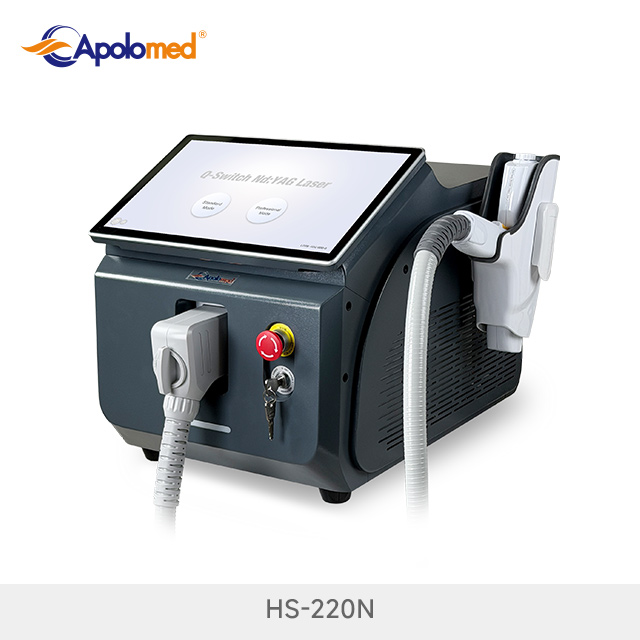
Most portable q-switched Nd:YAG models share three standard wavelengths. The common set includes 1064nm, 532nm, and 755nm. These devices use five treatment tips and carry similar regulatory standing. Peak energy output is the main differentiator.
Higher peak energy improves penetration and fragmentation. This directly impacts clinical efficacy. A low-fluence q-switched nd:yag laser mode expands options for melasma, freckles, and rejuvenation. Many practitioners adopt the low-fluence q-switched nd:yag laser approach for sensitive skin types. The combination of wavelength availability and energy output determines clinical versatility. Clinics that offer combination therapy for tattoo removal, pigmented lesions, and vascular lesions benefit from a versatile q-switched laser. The combination of peak energy and consistent efficacy makes this q-switched laser a reliable workhorse for most clinics.
Portable Q Switched Laser Models Side By Side
Key Specs Compared
A portable q switched laser shares core specifications across most brands. The standard wavelength set includes 1064 nm, 532 nm, and 755 nm. Pulse duration sits in the nanosecond range. Energy output varies by model, and peak energy is the primary differentiator. Weight typically ranges from a few kilograms to over ten, depending on the build. Battery life supports mobile use for several hours. Cooling design affects duty cycle and performance.
| Parameter | Air-Cooled Q-Switched Laser | Water-Cooled Q-Switched Laser |
|---|---|---|
| Chiller capacity required | None (ambient air cooling) | 0.5–2.0 kW |
| Coolant flow | N/A | 1–3 L/min |
| Maintenance focus | Fan filter cleaning every 250–500 h | Monthly coolant checks; DI changes quarterly |
| Thermal drift | Higher at high duty cycles | Fewer thermal drifts, better for production |
| Duty cycle impact | Limited by fan capacity and ambient temperature (15–30 °C) | Supports higher average power and duty cycle |
The q-switched laser machine category splits into four main types. A portable q-switched unit offers mobility and lower upfront cost. A vertical q-switched system delivers higher power for stationary clinics. A pico laser provides shorter pulses and greater efficacy for certain inks. A pico laser with long-pulsed Nd:YAG adds hair removal and vascular treatment capabilities. Each type serves different clinical needs.
Price And Value Positioning
Pricing for q-switched devices often starts under $2000. This offers strong value for startups and established clinics alike. The tattoo removal market continues to grow, and cost efficiency matters for return on investment.
Q-switched laser technology works the same as pico lasers, but at only one-tenth the price.
The portable laser can have the same energy as the vertical machine.
A q-switched laser typically carries a lower per-session price than a pico system. Pico lasers can reduce total sessions for certain inks, which may lower overall cost despite higher per-session fees. The technology difference influences efficiency and total cost. Clinics weighing price against performance should consider treatment volume and patient mix. A combination of q-switched and pico technologies can address diverse cases. The q-switched laser remains a cost-effective entry point for most clinics. Efficacy across tattoo removal, pigmented lesions, and skin toning makes it a versatile choice. A combination approach with topical agents or other devices expands clinical options. The q-switched laser delivers reliable results at a fraction of the price of pico systems.
Tattoo Removal Device Performance By Use Case
Black Ink And Colored Inks
A q-switched laser excels at clearing black and dark tattoo inks. The 1064 nm wavelength targets black pigment with high efficacy. A q-switched Nd:YAG device remains the standard for dark ink removal. Picosecond lasers handle bright colors like reds more effectively. The 532 nm wavelength addresses red, orange, and warm tones. Clinics offering combination therapy can pair wavelengths for multi-color tattoos. This combination approach improves outcomes across ink types.
Research confirms the efficacy of picosecond over nanosecond systems for black ink. A study by Park et al. (2021) reported picosecond Nd:YAG achieved 86.6% mean clearance after 6–8 sessions. The same study showed 61% clearance after only 2 sessions. Ross et al. demonstrated that picosecond outperformed nanosecond lasers at 1064 nm. Choi et al. found picosecond lasers more effective and safer in animal models.
| Ink Type | Clearance Goal | Picosecond Sessions | Nd:YAG Q-Switched Sessions |
|---|---|---|---|
| Professional black | >90% clearance | 3–5 | 5–10 |
| Amateur black | >90% clearance | 2–4 | 4–7 |
Both technologies rate excellent for black ink at 1064 nm. Picosecond achieves the same clearance in about half the sessions. A q-switched laser still delivers reliable efficacy at lower cost. The tattoo removal market values this combination of affordability and results.
Melasma And Benign Lesions
A low-fluence q-switched nd:yag laser protocol is standard for melasma treatment. This approach treats melasma lesions gently. The low-fluence q-switched nd:yag laser mode minimizes risk of post-inflammatory hyperpigmentation. Melasma treatment requires careful parameter selection. A low-fluence q-switched nd:yag laser session targets pigment without damaging surrounding tissue. The efficacy of this method for melasma is well documented. Combination therapy with topical agents enhances melasma treatment outcomes. This combination supports skin toning and rejuvenation.
Apolomed applications extend beyond tattoo removal. The device addresses wound removal, eyebrow tattoo removal, and lip liner removal. Soft peeling for skin toning and rejuvenation is another application. Vascular lesions such as telangiectasis respond well. Pigmented lesions including freckles, melasma, seborrheic keratosis, and Nevus of OTA are treatable. The q-switched laser handles epidermal and dermal hyperpigmentation. Melasma lesions and other hyperpigmentation conditions benefit from consistent treatment. The efficacy across these use cases makes the q-switched laser a versatile tool. Combination therapy protocols further expand clinical options for hyperpigmentation.
Ergonomics And Clinic Workflow
Portability And Heat Management
Device weight shapes daily workflow decisions. A portable q switched laser such as the YANYAO Model F13 weighs 22 kg. That figure suits mobile clinics, mobile beauty studios, and community skin management centers. A 15000mAh lithium battery delivers 4 hours of continuous work. Type-C fast charging reaches full capacity in 2 hours.
| Attribute | Value |
|---|---|
| Net weight | 22 kg |
| Battery type | 15000mAh lithium battery |
| Battery life | 4 hours continuous work |
| Charging | Type-C fast charging, fully charged in 2 hours |
Heat management determines duty cycle for any q-switched system. Pulsed operation modes reduce average power consumption by 60–80% compared to continuous wave operation.
Pulsed operation modes reduce average power consumption by 60–80% compared to continuous wave operation, thereby lowering heat generation and allowing a higher duty cycle in portable Q-switched lasers.
Temperature monitoring systems automatically reduce power when skin temperature exceeds safe thresholds. This feature enables extended wear periods without thermal damage. Passive cooling methods add bulk and weight. That trade-off limits duty cycle for a q-switched device in continuous use. Thermoelectric cooling systems manage heat dissipation in prolonged applications. A q-switched laser with efficient cooling supports higher patient throughput.
Maintenance And Downtime
Daily maintenance includes visual inspection of optical components, verification of cooling system function, and cleaning of external surfaces. Weekly tasks involve cleaning optical windows with manufacturer-approved lens cleaner and lint-free swabs. Monthly checks verify energy output with a calibrated energy meter. Alignment of the aiming beam requires inspection. Internal filters and fans need review after power-off and unplugging. Error logs should be reviewed monthly.
| Frequency | Task |
|---|---|
| Weekly | Clean and inspect optical windows/lenses; check coolant levels and filters |
| Monthly | Verify energy output with calibrated energy meter; check aiming beam alignment; inspect filters and fans; review error logs |
Compare recorded baseline energy at multiple fluence settings. If deviation exceeds manufacturer-specified tolerance, commonly ±10%, contact engineering for recalibration. Calibration procedures follow manufacturer specifications. Professional service is typically required at predetermined intervals or when energy output thresholds are reached. A q-switched laser with a predictable maintenance schedule minimizes downtime. This reliability supports consistent treatment delivery and protects the cost of ownership over time.
Pros And Cons At A Glance
Strengths Of Each Model
Each q-switched model brings distinct strengths to a clinic. A portable q-switched unit offers mobility and a lower upfront price. A vertical q-switched system delivers higher power for stationary, high-volume settings. A pico laser provides shorter pulses and greater efficacy for bright inks. A pico laser with long-pulsed Nd:YAG adds hair removal and vascular treatment. The q-switched laser remains a cost-effective workhorse across tattoo removal, pigmented lesions, and skin toning.
| Model Type | Primary Strength |
|---|---|
| Portable q-switched | Mobility, lower price, battery operation |
| Vertical q-switched | Higher peak energy, high throughput |
| Pico laser | Superior efficacy on bright inks |
| Pico with long-pulsed Nd:YAG | Added hair and vascular treatments |
Apolomed covers tattoo and wound removal, eyebrow and lip liner removal, soft peeling, telangiectasis, freckles, melasma, seborrheic keratosis, and Nevus of OTA. This combination of applications suits most clinic types.
Trade-Offs To Weigh
Peak energy limits separate budget models from premium systems. Lower peak energy reduces penetration and fragmentation. That gap affects efficacy on stubborn pigments. Price differences also matter. A q-switched device often starts under $2000, while pico systems carry a higher price per session. Service support varies by brand. Clinics should confirm calibration intervals and tip replacement availability before purchase.
The cost of ownership extends beyond the initial price. Maintenance schedules, coolant checks, and professional recalibration add to the total cost over time. A combination of q-switched and pico technologies can offset these trade-offs. This combination addresses diverse cases without over-relying on one platform. Buyers should weigh peak energy, price, and service support against expected treatment volume.
Which Model Fits Your Clinic
Mobile Clinic Vs Stationary High-Volume
Clinic type determines the right device more than any spec sheet. A stationary q-switched laser suits high-volume clinics. These systems provide stronger cooling and a more robust power supply for busy treatment days. Articulated arms on floor-standing units improve handpiece precision and reduce operator fatigue during long sessions. Longevity and reliability support heavy daily patient volume.
A portable q switched laser fits mobile practitioners, small treatment rooms, satellite spa owners, and market testers. These units allow equipment sharing without permanent installation. Technical advances have narrowed the performance gap between portable and stationary designs. Daily patient volume still affects durability. Q-switched systems use xenon lamps rated for 1,000,000–3,000,000 shots. High-volume clinics should verify lamp lifetime and replacement price before purchase.
Clinical needs also shape the choice. Darker skin tones generally require the 1064nm wavelength to reduce hypopigmentation risk. Lighter skin tones can use the 532nm wavelength. Certification such as CE and ISO13485 confirms compliance with international medical equipment standards. A q-switched laser machine with these marks meets recognized safety benchmarks.
| Criterion | Stationary Q-Switched Laser | Portable Q-Switched Laser |
|---|---|---|
| Cooling and power supply | Stronger cooling and power supply for busy clinic days | May have reduced power output or cooling efficiency, though technical advances have narrowed the gap |
| Best-suited clinic type | High-volume clinics serving many patients daily | Mobile practitioners, small treatment rooms, satellite spa owners, and market testers |
| Operational benefit | Articulated arms improve handpiece precision and reduce operator fatigue | Allows equipment sharing without permanent installation |
| Daily patient volume | Longevity and reliability support high daily volume | Better for smaller clinics or lower-volume and mobile use |
| Certification | CE and ISO13485 | CE and ISO13485 |
Why Apolomed Leads The Shortlist
Apolomed balances efficacy, safety, and return on investment across tattoo removal, melasma, and pigmented lesion treatments. The platform handles tattoo and wound removal, eyebrow tattoo removal, and lip liner removal. Soft peeling supports skin toning and rejuvenation. Vascular lesions such as telangiectasis respond well. Epidermal and dermal pigmented lesions, including freckles, melasma, seborrheic keratosis, and Nevus of OTA, are all treatable.
A low-fluence q-switched nd:yag laser protocol is standard for melasma treatment. This approach treats melasma lesions gently and minimizes the risk of post-inflammatory hyperpigmentation. A low-fluence q-switched nd:yag laser session targets pigment without damaging surrounding tissue. The efficacy of this method for melasma is well documented. Combination therapy with topical agents enhances melasma treatment outcomes. This combination supports skin toning and rejuvenation.
The tattoo removal device market rewards versatility. A q-switched laser delivers reliable efficacy at a lower price than pico systems. The cost of ownership stays predictable with a clear maintenance schedule. A combination of wavelengths addresses diverse ink colors and skin types. The efficacy across tattoo removal, melasma, and hyperpigmentation makes Apolomed a strong shortlist candidate. The cost per session remains competitive for startups and established clinics alike. For clinics weighing versatility, portability, and price, Apolomed offers a compelling balance.
Treatment versatility, portability, and budget define the right device. The combination of factors guides selection. Mobile clinics need a portable q switched laser. High-volume clinics need a stationary q-switched laser. Apolomed's q-switched platform stands as a tattoo removal device balancing efficacy and safety. Cost and price stay low. The combination of applications treats diverse needs. This combination delivers proven efficacy. Request consultation or demo today.
FAQ
Which portable q-switched laser suits a small clinic?
A portable q-switched unit fits small clinics well. The q-switched laser offers mobility and a lower price. A q-switched device handles tattoo removal, melasma, and pigmented lesions. The combination of portability and efficacy supports diverse clinic needs.
Can a q-switched laser treat melasma and hyperpigmentation?
Yes. A low-fluence q-switched nd:yag laser protocol is standard for melasma treatment. This q-switched approach treats melasma lesions gently. The low-fluence q-switched nd:yag laser mode minimizes post-inflammatory hyperpigmentation risk. Melasma treatment with combination therapy and topical agents enhances outcomes. The q-switched platform also addresses freckles, seborrheic keratosis, and Nevus of OTA. This combination of applications makes melasma treatment and hyperpigmentation care reliable.
How does combination therapy improve q-switched results?
Combination therapy pairs q-switched wavelengths with topical agents or other devices. This combination expands clinical options for tattoo removal and pigmented lesions. The q-switched laser supports combination therapy protocols. Efficacy improves across diverse ink colors and skin types. The combination of 1064 nm and 532 nm wavelengths addresses multi-color tattoos. A q-switched device with combination therapy delivers consistent efficacy. The price per session stays competitive for startups and established clinics.
Post time: Sep-11-2026


