Choosing body contouring equipment starts with one question: does your clinic want to build a heat-based fat-reduction service, a cooling-based fat-reduction service, or a muscle-stimulation service? A 1060nm diode laser, a cryolipolysis system, and an electromagnetic muscle stimulation system may all appear under “body contouring,” but they do not create the same appointment, room, staffing, or ownership model. This guide separates those technologies by service objective and then turns the comparison into a practical procurement decision.
A three-step purchasing path
First, identify what each modality is designed to do. Next, compare applicator capacity, room use, operator workload, and service dependencies. Finally, match one technology to verified local demand and request the exact configuration, documentation, training, and service package.
Define the Service Outcome Before Comparing Machines
The category name “non-invasive body contouring machine” is too broad to guide a purchase. Two devices may be marketed to the same clinic while targeting different tissues and producing different workflows. Comparing them only by power, number of applicators, or a list of body areas can hide the more important operational differences.
A clinic should first define the service outcome it wants to sell. A 1060nm diode laser body sculpture system uses controlled heat and contact cooling in a localized fat-contouring workflow. Cryolipolysis uses controlled cooling and suction or tissue coupling to create a different appointment experience. Electromagnetic stimulation is primarily a muscle-stimulation pathway and should not be treated as a direct substitute for either heat-assisted or cooling-based lipolysis.
- Heat-based fat-contouring pathway: evaluate laser output, applicator coverage, contact cooling, belt placement, and thermal monitoring.
- Cooling-based fat-contouring pathway: evaluate applicator fit, suction, temperature control, consumables, cleaning, and room occupancy.
- Muscle-stimulation pathway: evaluate applicator positioning, intensity control, training, contraindication screening, and how the service will be described without making unsupported equivalence claims.
This first distinction keeps the article—and the buying decision—focused. It also prevents a clinic from purchasing three overlapping “slimming” devices before confirming which service its existing patients will actually book. Clinics that want to review the available product routes first can use the Apolomed body slimming equipment category as a starting point, then return to the workflow comparison below.
1060nm Laser Body Contouring: Build Around Controlled Heat
The Apolomed HS-851 1060nm Sculpture Laser is the main product example in this comparison. Its value is not that it adds another general-purpose laser to a clinic. It establishes a dedicated, heat-assisted body-contouring workflow built around multiple belt-mounted applicators and contact cooling.
The FDA 510(k) summary for K201731 identifies the HS-851 as a 1060nm diode hyperthermic laser lipolysis system. The cleared indication covers non-invasive lipolysis of the abdomen, flanks, back, and thighs in individuals with a BMI of 30 or less, with the intent to affect the appearance of visible fat bulges in those areas. This scope is more useful for procurement than a generic “body slimming” claim because it defines the model, technology, intended regions, and user population that the regulatory record actually addresses.
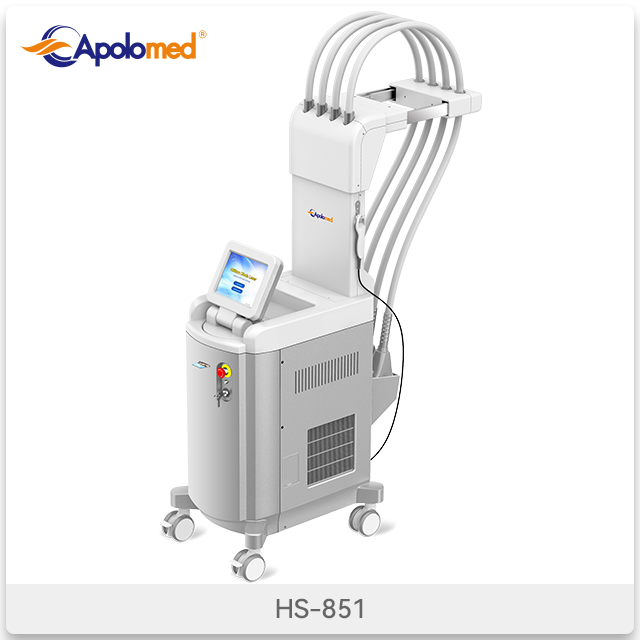
Apolomed HS-851 1060nm diode laser body sculpture system.
Translate the Published Configuration into Room Capacity
The manufacturer page lists four applicators, contact cooling, a 9.7-inch touch interface, and a 60kg floor-standing platform. The FDA summary describes 4 × 6cm² and 4 × 8cm² applicator-head options, up to four applicators per body treatment, power density of 0.8–1.6W/cm², and contact cooling. These numbers matter only when translated into workflow: how many applicators are included in the quoted package, whether all can operate in the intended combination, how belts are positioned, and how much operator time is required for setup and removal.
The product page contains inconsistent applicator-size wording in different sections, so the purchase order should specify the exact applicator dimensions and part numbers rather than relying on a general website description. A live demonstration should also confirm contact cooling, cable reach, belt fit, software presets, alarm behavior, and sustained operation with the planned applicator arrangement.
Cryolipolysis: Plan for Coupling, Cooling, and Room Time
The HS-580 Cryolipolysis System represents a different body-contouring workflow. The manufacturer page lists four applicators that can work at the same time, adjustable suction, a published treatment-temperature range, and a stated 30–60 minute treatment time. These are manufacturer-listed specifications and should be confirmed against the current manual and quotation before purchase.
For a clinic, the central question is not whether cooling sounds more or less advanced than laser heating. It is whether the cryolipolysis workflow fits the available room, patient positioning, applicator inventory, turnover procedure, and consumable supply. Suction-based coupling can require more preparation and post-appointment cleaning than a flat applicator system. Applicator shape also determines whether the purchased set matches the treatment areas the clinic plans to offer.
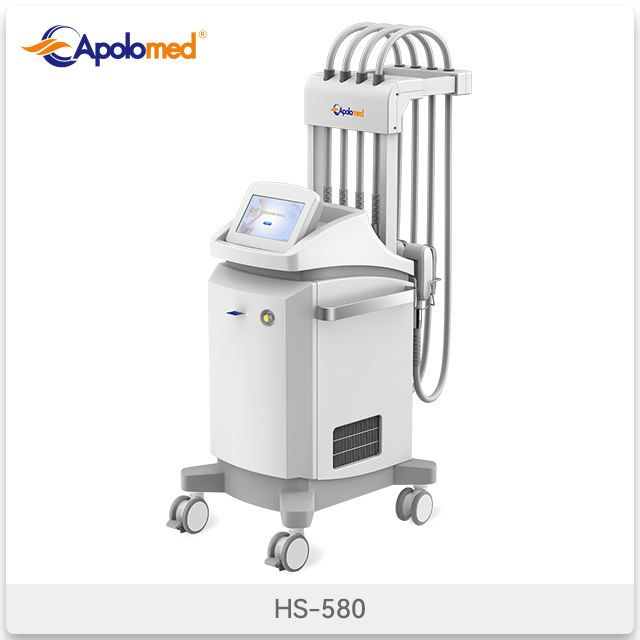
Apolomed HS-580 cryolipolysis system; verify the supplied applicator set and consumables in the quotation.
Ask What “Four Applicators” Means in Practice
A high applicator count can improve capacity only if the system supports the required simultaneous operation, the applicators fit the intended areas, and the clinic has enough staff time to position and monitor them. The buyer should request the included applicator sizes, replacement price, membrane or liner requirements, hose and connector warranty, cleaning instructions, and temperature-control verification procedure. Without those details, a headline applicator count is not yet a capacity model.
EMS: Keep Muscle Stimulation on a Separate Decision Path
The HS-591 Electromagnetic Muscle Stimulation System should be evaluated as a muscle-stimulation and body-shaping platform, not as a like-for-like substitute for 1060nm laser lipolysis or cryolipolysis. The manufacturer lists five applicators, a 9.7-inch touch interface, air cooling, and adjustable system settings. It also makes strong marketing claims about simulated exercise and fat reduction; those claims should not replace the clinic’s own review of labeling, training material, contraindications, and applicable regulatory documents.
Operationally, EMS shifts the buying discussion toward applicator fixation, repeatable placement, patient screening, intensity progression, noise, operator oversight, and how the service is described in consultations. A clinic whose primary objective is visible fat-bulge reduction should not choose an EMS system merely because it appears in the same “body contouring” category. Conversely, a clinic building a muscle-conditioning or body-shaping service may not need a thermal fat-contouring device as its first investment.
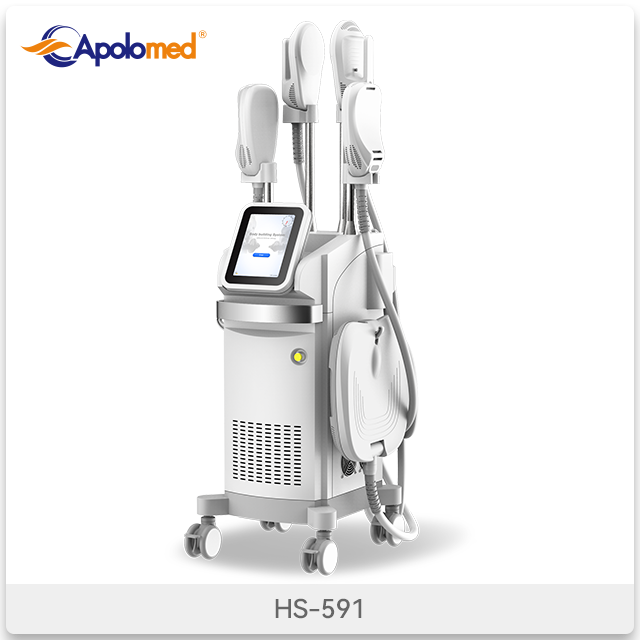
Apolomed HS-591 electromagnetic muscle stimulation system.
Match Each Technology to the Clinic Workflow
A meaningful comparison should focus on what changes inside the clinic. The following table does not rank clinical outcomes. It maps each modality to the workflow and procurement questions that must be verified before purchase.
| Decision Factor | 1060nm Laser | Cryolipolysis | EMS |
|---|---|---|---|
| Primary pathway | Heat-assisted localized fat-contouring workflow | Controlled-cooling fat-contouring workflow | Electromagnetic muscle-stimulation workflow |
| Applicator logic | Belt-mounted, non-suction applicators with contact cooling | Cooling applicators selected by shape, fit, and suction requirements | Fixed electromagnetic applicators requiring repeatable positioning |
| Capacity driver | Included applicators, supported combinations, setup, and cooling | Applicator inventory, simultaneous use, appointment duration, and turnover | Number of supported applicators, fixation, protocol, and oversight |
| Key ownership costs | Applicators, cooling, belts, optics, service, and downtime | Applicators, cooling system, liners or membranes, hoses, and service | Applicators, fixation accessories, cables, software, training, and service |
| Best first fit | Clinics prioritizing a documented 1060nm heat-based fat-contouring service | Clinics prepared for cooling, suction, consumables, and longer room occupancy | Clinics prioritizing muscle stimulation and body shaping as a separate service line |
If a clinic is also deciding whether to consolidate multiple technologies on one chassis or purchase dedicated systems, the separate guide on modular aesthetic platforms versus standalone lasers addresses that equipment-architecture decision. The present comparison stays focused on body-contouring modality selection.
Model Sellable Capacity Before Estimating ROI
An ROI estimate becomes useful only after a clinic models sellable appointment capacity. A device with more applicators is not automatically more profitable. The real constraint may be room availability, staff setup time, patient eligibility, treatment-area demand, consumable supply, or the ability to keep the system operating when one applicator requires service.
Use a local capacity model
Weekly sellable sessions = available room hours ÷ total appointment block × realistic booking rate.
Contribution before fixed overhead = collected session revenue − consumables − allocated operator time − financing − service reserve − expected downtime cost.
Use the clinic’s own pricing, payroll, cancellation rate, room schedule, and local demand. Do not import a supplier’s example revenue figure into the business case. Build three scenarios—conservative, expected, and capacity-constrained—and test what happens if bookings ramp more slowly or one applicator is unavailable.
Ownership Costs to Request in Writing
- Exact main unit, applicator set, belts, fixtures, cables, and included accessories.
- Installation, electrical requirements, room conditions, delivery, and commissioning.
- Training scope, operator materials, refresher training, and remote support.
- Consumables, cleaning supplies, liners or membranes where applicable, and reorder lead time.
- Warranty by component, preventive maintenance, replacement applicator pricing, and service turnaround.
- Software access, updates, error logs, exportable service records, and post-warranty support.
Verify the Exact Device, Labeling, and Documentation
For the HS-851, the FDA K201731 clearance record provides a model-specific reference point. It identifies Shanghai Apolo Medical Technology Co., Ltd., the Diode Laser Body Sculpture System, product code PKT, and the cleared indication described earlier. Buyers should still match the quotation, device label, user manual, applicator options, and intended-use language to the delivered system. A clearance record is not a substitute for checking the actual configuration.
The HS-580 and HS-591 product pages list ISO 13485, SGS RoHS, and CE statements. In this article, those are treated as manufacturer-published claims rather than independent verification of every delivered configuration. Before purchase, request the current certificate, issuing body, legal manufacturer, model coverage, validity dates, declaration of conformity where applicable, and local market requirements.
| Document | What to Match | Why It Matters |
|---|---|---|
| Quotation and packing list | Model, applicator quantity, sizes, accessories, software, and spare parts | Prevents a category-level description from replacing the exact order |
| Regulatory record or certificate | Legal manufacturer, model, intended use, accessories, dates, and market | Stops one model’s status from being extended to another configuration |
| Acceptance record | Serial number, safety checks, output or temperature checks, alarms, training, and sign-off | Creates a usable baseline for warranty and future service |
Which Body Contouring System Fits Your Clinic?
Choose a 1060nm laser pathway when the clinic intends to build a documented, heat-based fat-contouring service and can support belt placement, contact cooling, multiple applicators, and laser-specific training. HS-851 is especially relevant when the purchasing team wants a model with a traceable FDA 510(k) record and can match the delivered configuration to that record.
Choose a cryolipolysis pathway when local demand supports cooling-based fat contouring and the clinic can manage applicator fit, suction, consumables, cleaning, and longer room occupancy. The decision should be based on included applicator shapes and real simultaneous-use capacity, not the category name alone.
Choose an EMS pathway when muscle stimulation and body shaping are the primary service goals. Keep the consultation language, staff training, contraindication screening, and evidence review aligned with that objective instead of presenting EMS as interchangeable with thermal or cooling-based lipolysis.
Delay the purchase when demand is untested, the room schedule is already constrained, or the supplier has not provided a configuration-specific document pack. A staged launch with one clearly positioned modality is usually easier to measure than introducing several technologies with overlapping marketing language.
Conclusion: Buy a Service Model, Not a Category Label
The right body contouring equipment is the system that fits a defined service outcome, a realistic appointment model, and verifiable documentation. The HS-851 supports a 1060nm heat-assisted pathway; HS-580 represents a cooling-based pathway; and HS-591 belongs to a separate muscle-stimulation pathway. Their value cannot be reduced to one specification or a generic “slimming” claim.
Request a modality-matched configuration
Share your primary service goal, planned treatment areas, available treatment rooms, and expected weekly bookings to request a configuration-specific quotation and document pack.
Frequently Asked Questions
Do 1060nm laser and cryolipolysis solve the same purchasing need?
They may compete for some of the same body-contouring budgets, but they create different technical and operational workflows. A 1060nm laser system uses controlled heat with contact cooling, while cryolipolysis uses controlled cooling and commonly involves suction or tissue coupling. Compare room time, applicator fit, consumables, cleaning, training, and local demand—not only the treatment category.
Can EMS replace a fat-contouring device?
Not as a direct one-for-one replacement. EMS should be evaluated primarily as a muscle-stimulation and body-shaping service. If the clinic’s principal purchasing objective is non-invasive lipolysis or visible fat-bulge reduction, it should separately assess a device with the corresponding intended use and documentation. The service menu should describe these pathways accurately rather than merging them under one promise.
Does a higher applicator count always mean more capacity?
No. Capacity depends on supported simultaneous operation, applicator fit, setup time, treatment-room availability, cleaning, staff oversight, and the proportion of patients who need each configuration. Ask the supplier to demonstrate the exact included applicators operating in the combinations your clinic plans to use, then model sessions using your actual appointment blocks and booking rate.
Which costs are commonly missed in a body contouring equipment quote?
Common omissions include shipping, installation, electrical preparation, belts or fixtures, liners or membranes, cleaning supplies, replacement applicators, cooling-system service, software access, refresher training, travel for technicians, and revenue lost during downtime. Request separate warranty terms for the main unit, applicators, cables, cooling components, and accessories.
How should a clinic verify FDA or CE statements?
Match the legal manufacturer, exact model, intended use, accessories, and market to the original regulatory record or current certificate. For HS-851, K201731 provides a model-specific FDA clearance reference. For supplier-published CE or quality-system statements, request the current underlying documents and confirm that they cover the quoted model. Do not extend one product’s status to another model in the same category.
Post time: Oct-27-2026


