The right diode laser hair removal machine is not simply the model with the highest wattage. Clinics need to compare wavelength configuration, spot size, pulse control, cooling stability, treatment modes, compliance documentation, and service support. A triple-wavelength platform can broaden treatment flexibility, but only when the handpiece, cooling system, interface, and workflow match the clinic’s actual patient mix. This guide uses Apolomed’s vertical triple-wave platform as the main reference and compares it with a portable diode laser configuration. It explains what the published specifications mean, which questions buyers should ask, and how to build a shortlist without relying on a single marketing claim.
Why Triple-Wavelength Diode Laser Technology Matters
How 755nm, 810nm, and 1064nm Work Together
A diode laser hair removal machine directs controlled optical energy toward melanin in the hair follicle. The absorbed energy becomes heat, which is intended to damage the follicular structures involved in regrowth while the surrounding skin is protected through parameter selection and cooling. An 810nm diode laser is widely used because it offers a practical balance between melanin absorption and penetration depth. A triple-wave configuration adds 755nm and 1064nm options to extend the treatment range within one handpiece.
The three wavelengths should not be treated as interchangeable labels. The shorter 755nm wavelength has stronger melanin affinity and is commonly associated with finer or lighter hair targets, while 810nm serves as the central workhorse wavelength for many routine applications. The longer 1064nm wavelength penetrates more deeply and has lower relative melanin absorption, which can support protocol flexibility for darker skin tones when settings are selected by a trained operator. The practical value is coverage: a clinic can address a wider range of hair characteristics and skin profiles without changing platforms.
One Handpiece, Multiple Treatment Depths
Apolomed states that its vertical diode laser combines 755nm, 810nm, and 1064nm in a single handpiece. This design is intended to target different follicle depths during treatment. For a busy clinic, the main operational benefit is not simply having three numbers on a specification sheet. It is the ability to standardize training and reduce equipment changes while maintaining protocol flexibility. Buyers should still confirm whether all three wavelengths are emitted simultaneously, independently selectable, or supplied as different configurations. The answer affects treatment planning, staff training, replacement costs, and the way the system should be marketed to clients.
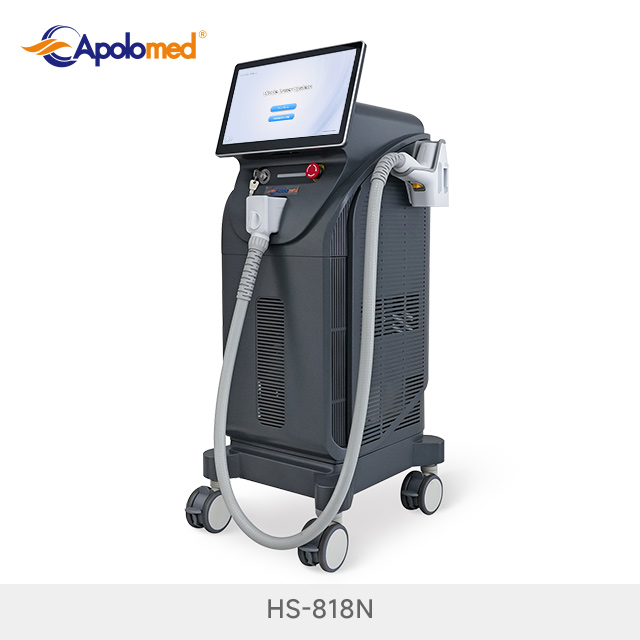
Apolomed vertical diode laser platform with triple-wave configuration options.
Key Specifications of the Vertical Diode Laser Platform
Published Configuration at a Glance
The supplier page lists several options for the vertical platform rather than one fixed configuration. That distinction matters. A buyer should match the quotation, nameplate, handpiece, software interface, and compliance documents to the exact unit being ordered. The following table summarizes the specifications published on the Apolomed vertical diode laser product page.
| Parameter | Published Options |
|---|---|
| Wavelength | 810nm / Dual-wave 755+810nm / Triple-wave configuration |
| Laser output | 1600W / 1800W / 3000W options |
| Spot sizes | 12×14mm, 12×30mm, Φ6mm, 12×12mm, 12×25mm, and 12×35mm options |
| Energy density | 1–72 J/cm² or 1–45 J/cm², depending on configuration |
| Pulse width | 10–200ms or 10–150ms |
| Repetition rate | 1–15Hz |
| Sapphire cooling | Published range: −4°C to 4°C |
| Cooling system | TEC or compressor cooling system |
| Interface | 15.6-inch or 18.5-inch true-color touchscreen |
| Dimensions and weight | 42×50×110cm; 58.5kg |
Why Power Alone Does Not Decide Performance
Laser output is often the first number buyers compare, but wattage does not independently predict treatment quality. Useful performance depends on how the system converts electrical input into stable optical output at the treatment window. Spot size, fluence range, pulse width, repetition rate, thermal control, and calibration all affect the result. A high-output machine with unstable cooling may require pauses or conservative settings. A lower-output system with consistent pulse delivery may perform more predictably in a moderate-volume clinic.
Ask the supplier to demonstrate energy consistency during an extended session, not only during a short startup test. Confirm whether the quoted wattage refers to diode stack power, electrical consumption, or measured optical output. Buyers should also request the exact spot size and repetition rate available at the intended fluence. Maximum values may not always operate simultaneously. A clear performance envelope is more useful than a list of isolated maximum specifications.
SHR, Stack, and SSR Treatment Modes Explained
SHR Mode for In-Motion Hair Removal
According to the product description, SHR mode uses low-energy pulses at a high repetition rate to build heat gradually in the dermis. The handpiece moves repeatedly across the treatment area instead of remaining stationary for one high-fluence pulse. This in-motion method can support even coverage across larger areas such as legs, back, arms, and abdomen. The operator must still control pass count, overlap, endpoint observation, and skin cooling. A fast repetition rate does not remove the need for careful technique.
Stack Mode for Smaller Areas
Stack mode is positioned for smaller or difficult-to-reach areas, including fingers, toes, the hairline, temples, and the bikini area. These locations require more precise placement than broad in-motion passes. Clinics should confirm which spot sizes and protocol presets are supplied with the ordered handpiece. A smaller treatment window may improve access and control, while larger windows improve speed on broad body areas. The best configuration depends on the clinic’s service mix rather than a single universal spot size.
SSR Mode and Service Expansion
The supplier describes SSR as “Super Skin Rejuvenation” for body skin rejuvenation and toning. Clinics considering this mode should review the device’s cleared or certified intended uses before promoting additional services. A software label does not by itself establish a regulatory indication or a clinical protocol. Ask for training materials, treatment parameters, contraindications, and documentation that corresponds to the exact market and device configuration. Service expansion can improve equipment utilization, but only when claims, operator qualifications, and local regulations are aligned.
Spot Size, Speed, and Clinic Throughput
Match the Treatment Window to the Body Area
A large spot size covers more skin per pulse and can reduce the number of passes required for broad areas. The vertical platform lists options up to 12×35mm, while the portable HS-810 page lists 12×18mm and 12×30mm configurations. Larger windows can improve throughput, but handpiece ergonomics, pulse stability, and cooling contact remain equally important. A heavy handpiece or uneven sapphire contact may offset the theoretical speed advantage during a full day of treatments.
Repetition rate also affects pace. The vertical model lists up to 15Hz, while the HS-810 lists up to 10Hz. These maximum rates should be evaluated at clinically relevant settings. During a live demonstration, ask the operator to run the handpiece at the spot size, pulse width, fluence, and cooling level your team expects to use. Observe whether the system slows, overheats, or changes pulse rhythm during sustained operation.
A useful throughput test combines four variables: treatment window, repetition rate, handpiece weight, and cooling stability. Comparing only the largest spot size can produce a misleading purchasing decision.
Build a Realistic Capacity Estimate
Estimate daily capacity using real appointment steps: consultation, skin assessment, preparation, test spot when required, treatment, cleaning, documentation, and room turnover. The laser firing time is only one part of the appointment. Compare the projected appointment duration with the clinic’s demand by body area. A practice focused on full legs and backs may benefit more from a large spot and high repetition rate. A clinic serving smaller facial or bikini areas may prioritize precision, accessory sizes, and operator control.
Cooling and Comfort During Repeated Treatments
Sapphire Contact Cooling
The published specification lists sapphire cooling from −4°C to 4°C. Contact cooling helps remove heat from the epidermal surface while laser energy is delivered toward the follicle. For the buyer, the important question is not only the lowest displayed temperature. Cooling recovery, uniformity across the window, condensation control, and temperature stability during long sessions determine practical comfort and reliability.
TEC Versus Compressor Cooling
The vertical platform lists TEC or compressor cooling options. TEC modules are compact and can support controlled cooling, while compressor systems are often selected when stronger thermal management is needed. The correct choice depends on treatment volume, room temperature, duty cycle, maintenance capacity, and noise tolerance. Ask how long the system can operate continuously at the intended settings and what maintenance the cooling circuit requires.
Before purchase, test the machine after it has been running rather than immediately after startup. Check the treatment window temperature, handpiece surface, water-flow alerts, fan noise, and any automatic power reduction. Review cleaning procedures and coolant requirements. Stable thermal management protects the client experience, supports predictable energy delivery, and reduces interruptions during high-volume schedules.
Vertical vs. Portable Diode Laser Machines
Comparing the Vertical Platform with HS-810
A vertical diode laser suits clinics that expect a fixed treatment room, larger interface, and higher published output options. A portable configuration can fit smaller rooms, mobile services, or a lower-volume startup. The HS-810 product page lists an 8-inch touchscreen, 35kg weight, 800W or 1200W output options, and configurations including 810nm, dual-wave, or triple-wave.
| Decision Factor | Vertical Platform | HS-810 Portable |
|---|---|---|
| Published output options | 1600W / 1800W / 3000W | 800W / 1200W |
| Maximum listed repetition rate | 15Hz | 10Hz |
| Interface | 15.6-inch or 18.5-inch touchscreen | 8-inch touchscreen |
| Dimensions | 42×50×110cm | 60×38×40cm |
| Weight | 58.5kg | 35kg |
| Best operational fit | Fixed clinic room and higher-volume workflow | Smaller rooms, flexible placement, or moderate volume |
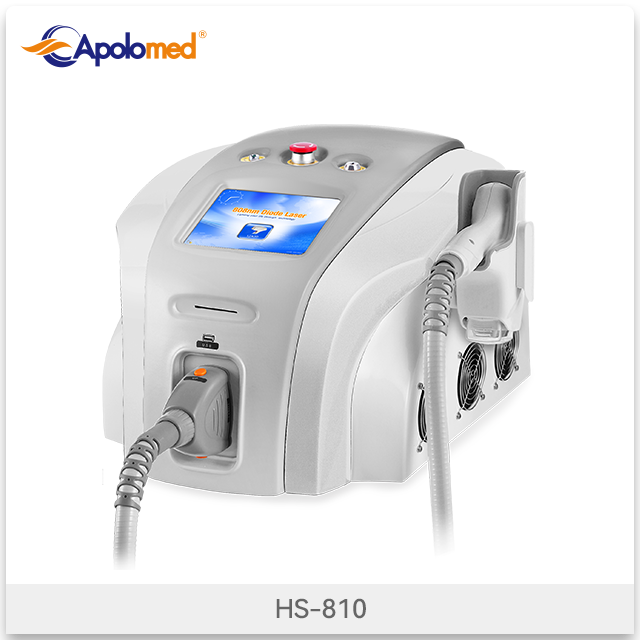
HS-810 portable diode laser shown as a lower-weight comparison to the vertical platform.
Neither format is automatically better. The vertical unit offers a larger operating console and higher published power options, but it takes more floor space and is heavier. The portable model is easier to position, yet buyers should test whether its cooling and sustained output match the expected appointment volume. Select the format around room layout, staff movement, service mix, and realistic daily duty cycle.
Compliance and Documentation Checks Before Purchase
Treat Website Claims as a Starting Point
The Apolomed page describes the vertical diode laser as Medical CE approved and US FDA 510(k) cleared. Buyers should treat this statement as a request for documentation, not as the final verification step. Certification and clearance apply to defined manufacturers, models, intended uses, and configurations. A similar housing, upgraded handpiece, different wavelength option, or distributor label may not automatically fall under the same record.
Before ordering, request the exact legal manufacturer name, model designation, certificate or clearance number, intended use, product code, labeling, and configuration covered. Match those details against the quotation and device nameplate. For CE documentation, check the applicable regulatory framework and notified body information where relevant. For the United States, verify the exact record through official FDA resources rather than relying on a certificate image or a general “FDA” badge.
Documents to Request from the Supplier
- Exact model name and configuration shown on the quotation and nameplate
- Applicable CE certificate or FDA 510(k) record and the covered intended use
- User manual, contraindications, treatment protocols, and operator training outline
- Calibration or energy-output test report for the supplied unit or batch
- Warranty scope for console, diode module, handpiece, screen, cooling system, and consumables
- Spare-parts list, expected lead times, software update policy, and technical support process
This documentation protects more than regulatory compliance. It clarifies which treatment claims the clinic can responsibly make, who may operate the equipment, what maintenance is required, and how quickly service can restore the machine after a fault. A strong purchase file also supports staff training, insurance review, and future audits.
Calculating Value and Return on Investment
Use Total Cost of Ownership, Not Purchase Price Alone
A diode laser hair removal machine creates value through treatment capacity, utilization, reliability, and client retention. The initial purchase price is only one component. Clinics should include financing, shipping, import costs, installation, operator training, room preparation, insurance, preventive maintenance, handpiece replacement, cooling-system service, consumables, software fees, and expected downtime.
Build the calculation from local data rather than an industry-wide revenue promise. Start with the clinic’s average treatment price by body area, expected bookings per week, realistic treatment duration, staff cost per appointment, and variable consumables. Then subtract monthly ownership and maintenance costs. Apply a conservative utilization rate during the launch period. A machine with higher capacity does not produce a return unless the clinic can generate and retain enough demand.
Questions That Protect Long-Term Profitability
Ask whether the diode module or handpiece has a defined shot-life rating, how replacement is priced, and whether the warranty is based on months, shots, or both. Confirm what happens if the touchscreen, water-flow sensor, compressor, or handpiece fails. Determine whether remote diagnosis is available and where spare parts are stocked. A low purchase price can lose its advantage when parts are unavailable or technical support requires lengthy international shipping.
The best value comes from a configuration that the clinic can operate consistently. A large spot size and high repetition rate support volume; small spot options support precision; strong cooling supports comfort and sustained sessions; clear documentation reduces operational risk. Rank each feature against expected revenue rather than choosing the model with the longest specification sheet.
Which Diode Laser Configuration Fits Your Clinic?
Choose the Vertical Platform When
A vertical platform is a strong shortlist candidate when the clinic has a dedicated treatment room, expects regular full-body treatments, values a large touchscreen, and needs multiple spot-size options. Higher published output and repetition-rate options may support demanding schedules, provided the cooling system maintains stable performance. Clinics planning to use SHR, Stack, and SSR modes should confirm training and permitted indications for every planned service.
Choose a Portable Platform When
A portable unit can suit smaller rooms, shared treatment spaces, mobile teams, or clinics testing demand before committing to a larger platform. The HS-810 weighs less and lists a smaller console, while still offering 810nm, dual-wave, and triple-wave options. Portable does not mean effortless transport: a 35kg system still requires safe handling and stable placement. Buyers should verify wheel cases, packaging, setup time, water-circuit requirements, and whether frequent movement affects calibration or warranty coverage.
A Five-Step Shortlisting Process
| Step | Decision | Evidence to Collect |
|---|---|---|
| 1 | Define patient mix | Skin tones, hair characteristics, body areas, and weekly demand |
| 2 | Match configuration | Wavelengths, output, spot sizes, pulse range, and treatment modes |
| 3 | Test sustained operation | Live demo at intended settings, cooling stability, ergonomics, and noise |
| 4 | Verify documentation | Exact model, intended use, certificates, clearance record, manual, and warranty |
| 5 | Calculate ownership cost | Training, maintenance, replacements, downtime, and local service response |
Apolomed’s vertical triple-wave diode laser offers a practical combination of wavelength options, multiple treatment modes, spot-size choices, contact cooling, and a large operating interface. The portable HS-810 provides an alternative for clinics that place greater weight on space and mobility. The final decision should be based on the exact ordered configuration and independently checked documentation—not a category page or maximum specification alone. Request a configuration-specific quotation, live demonstration, compliance file, warranty schedule, and service plan before committing to a purchase.
FAQ
Is a triple-wavelength diode laser better than a single 810nm machine?
It offers broader protocol flexibility, but it is not automatically better for every clinic. A single 810nm platform may meet the needs of a focused practice. Triple-wave value depends on the patient mix, operator training, real optical output, cooling stability, and whether the wavelengths are delivered in the configuration the clinic expects.
What spot size should a clinic choose?
Large spot sizes support faster coverage on legs, back, and other broad areas. Smaller spot sizes improve access around fingers, toes, the hairline, and the bikini area. Clinics offering mixed body-area services should compare a handpiece system with multiple treatment windows or confirm that compatible accessory sizes are included.
Does higher wattage guarantee faster hair removal?
No. Wattage must be evaluated with spot size, energy density, pulse width, repetition rate, cooling, calibration, and sustained output. Ask the supplier to demonstrate the exact configuration at treatment-relevant settings instead of comparing maximum power figures in isolation.
Should buyers choose TEC or compressor cooling?
The best choice depends on appointment volume, climate, noise limits, maintenance capability, and the system’s thermal design. Test cooling stability after sustained operation. The lowest startup temperature is less informative than consistent contact cooling throughout a full treatment schedule.
How should a clinic verify FDA or CE claims?
Request the exact manufacturer, model, record or certificate number, intended use, labeling, and covered configuration. Match every detail to the quotation and nameplate, then check the appropriate official regulatory database or documentation. A website badge or general supplier statement should not replace configuration-specific verification.
Post time: Sep-23-2026


